Many sponsors in the medical device research industry are challenged with the decision between having a remote or on-site initiation visit. An initiation visit is imperative to the overall success of a study as many tasks are accomplished during these visits.
Read More
It’s been a long time coming but at last the “rules”- the Physician Payment Sunshine Act is final. These are intended to give the public easier access to information on healthcare providers and their financial ties to companies in order to decrease any underlying or potential bias. How will this be accomplished?
Read More

Do you know why rules, regulations and standards exist? What exactly is Good Clinical Practice and how does this help protect patients and data integrity?
Read More
We recognize that it might not be easy to quickly grasp the concept behind the FAIR Shake™ training program, so we have posted a video on our company website that we believe will give you a better understanding of the training program. Sandra Maddock, CEO and President of IMARC, is featured in the video and walks you through the training methodology.
Read More
Stemming from the much anticipated Medical Device User Fee & Modernization Act (MDUFMA), FDA issued a new guidance regarding Premarket Approval Applications (PMAs) review and approval timelines. As the guidance plainly states in the introduction “the additional funds obtained from user fees will enable FDA, with the cooperation of industry, to improve the device review process to meet certain performance goals and implement improvements for the medical device review process.”
Read More
At times, a Sponsor may provide a site with a memo allowing the site to enroll a patient who does not meet all inclusion or exclusion criteria. Or a Sponsor may give the site pre-approval to deviate from the protocol-defined visit windows. Is this waiver enough? Would the investigative site be covered in the event of a federal audit?
Read More
In August 2011, FDA released a draft guidance document recommending a Risk-Based approach to monitoring. Risk- Based Monitoring combines the vigilance and data surveillance (key features of Electronic Data Capture systems) with traditional on-site data verification targeting critical data points. Rather than a standardized monitoring plan, Risk-Based Monitoring aims to adapt the monitoring plan to the changing needs of the Study, Site and Investigational Product.
Read More
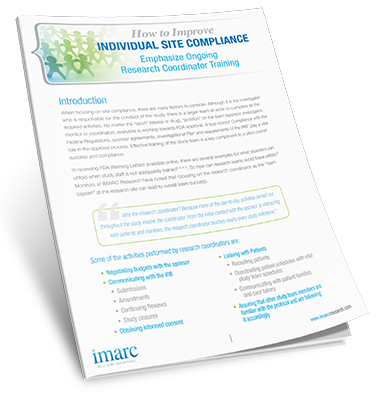
In order to run a well-controlled compliant study at the site level, one must ensure that the study team has been trained, and is knowledgeable on the rules and regulations. Although it is the Investigator who is responsible for the conduct of the study, there is a larger team at work to complete all the required activities. The research coordinator carries out many of the day-to-day activities and touches nearly every study milestone.
Read More
“The new proposal aims to fulfill a European Parliament request for more stringent med-tech scrutiny by bolstering an existing pre-market review system with additional checks and more transparency.” Sound familiar? You might be surprised to learn that this excerpt was not in reference to FDA.
Read More