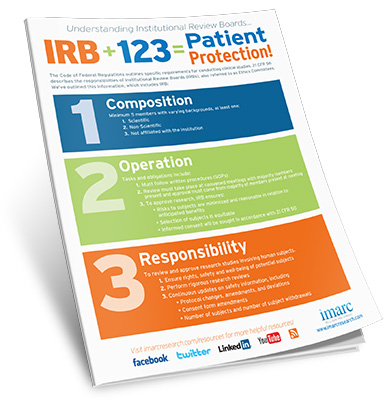
The key players in a clinical investigation are infamously made up of Sponsors, monitors, investigative sites, and patients. A fundamental part of the team is also the Institutional Review Board (IRB), as they oversee the conduct of clinical research. Per the FDA’s IRB information sheet, “IRBs are responsible for continuing review of ongoing research to ensure that the rights and welfare of human subjects are protected.” That’s a tall order!
Read More
Often, when one thinks of the team that actually brings a new medical device or drug to market, the first people that come to mind are those at the sponsor company and the investigators at the individual sites – the leaders of the study. What may be less known, though, is that often the study hinges on the shoulders of the Clinical Research Coordinator (CRC). Briefly, CRCs are responsible for the accurate maintenance of the records for the trial, as well as many parts of the trial that otherwise may be overlooked. Some of the major responsibilities of the CRC are:
Read More
During a recent monitoring visit to a site, I was witness to an IRB in action. Going in, I knew that this site had multiple issues. Three monitors were at the site during this time as there was an incredible amount of data to review. As I began looking at the data for the study, it was apparent that there were many inconsistencies at this particular site.
Read More
I came across an interesting article which talked about sponsor communication with an IRB. In a nutshell, it explained: Sponsor communication with IRBs has long been deemed inappropriate and since the 1980’s, sponsors having direct contact with an IRB has been frowned upon. Per Paul Goebel, president of Paul W. Goebel Consulting, Inc., a clinical research consulting firm, and former chief of CDE’s Institutional Review Branch, “When the regs were first written, some FDA officials said the communications should go through the principal investigator to keep the sponsors from bullying the IRBs and to keep IRBs safe from undue influence by the sponsors.”
Read More
The Code of Federal Regulations define vulnerable research subjects, and how those vulnerable subjects should be protected. 21 CFR 50.53 describes the circumstances under which children may participate in an investigation involving greater than minimal risk and no prospect of direct benefit . In order for these subjects to participate in clinical research trials, it is the researcher’s duty to ensure that these special protections are respected. It is unimaginable that these federally mandated laws and regulations could be discounted and ignored.
Read More
Dr. K. Kringle
Adjunct Professor of Child Psychology
Far Northern University
Read More