

<img height="1" width="1" style="display:none" src="https://www.facebook.com/tr?id=213807269037206&ev=PageView&noscript=1">
IMARC Blog

Compliance In Focus

FILTER BY:

Newest Post

Mary Lewis

Recent Posts

Posted by Mary Lewis on Tue, Jul 18, 2017

Take a Quality Snapshot of Your Clinical Study

How is auditing different than monitoring? Why do we need to audit? Since these questions are so often asked, we decided to create a graphic that will help you understand when to consider an audit. In short, auditing brings an independent, quality assurance perspective to the clinical research landscape Investigational sites, sponsors, and vendors benefit from high-level process assessments and improvements. Experienced auditors leverage extensive training to help ensure subject safety, data integrity, and protocol and regulatory compliance.

Topics: Auditing, Quality Assurance

Posted by Mary Lewis on Tue, Jan 17, 2017

How to Prepare for an FDA Audit

You’ve received “the call” from the FDA auditor. After an understandable quick moment of panic, what should your next steps be?

Topics: FDA Audit, BIMO Checklist

Posted by Mary Lewis on Wed, Aug 24, 2016

What is the Difference: Auditing vs. Monitoring?

In the realm of clinical research, two functions often work together to complement each other to create an additive impact on the overall quality and integrity of a clinical trial. The two functions are clinical monitoring and auditing. But how do these work hand-in-hand, and how are they different?

Topics: Auditing, Monitoring

Posted by Mary Lewis on Tue, Jun 14, 2016

Preparing for an FDA Audit

You’ve received “the call” from the FDA auditor. After an understandable quick moment of panic, what should your next steps be?

At IMARC, we have participated in the audit preparation process for numerous sites who have been contacted for an FDA audit. It is helpful for a site to know what the FDA auditor will use during their review. In a past blog, we discussed a new document introducing a standardized Nonconformity Grading System, which was created by the former Global Harmonization Task Force (now re-named International Medical Device Regulators Forum) to assist regulatory authorities and auditing organizations.

Topics: BIMO Checklist, FDA Audit

Posted by Mary Lewis on Wed, Jan 27, 2016

21 CR 812.100: A Medical Auditor's Favorite Regulation

I am often asked by industry colleagues that if I had to pick just one “favorite” federal regulation what would it be?  The answer is easily 21 CFR 812.100, as this regulation embodies 95% of the investigational site non-compliances  I observe as I conduct clinical investigator audits. Let me elaborate.

21 CFR 812.100 falls under Subpart E- Responsibilities of Investigators of the IDE Regulations.  This regulation succinctly details investigator responsibilities in just two sentences.

Topics: Investigator Responsibilities, Clinical Reearch, FDA, 21 CR 812.100

Posted by Mary Lewis on Mon, Nov 06, 2017

FDA Audit Prep

You’ve received “the call” from the FDA auditor.  After an understandable quick moment of panic, what should your next steps be?

At IMARC, we have participated in the audit preparation process for numerous sites who have been contacted for an FDA audit.  It is helpful for a site to know what the FDA auditor will use during their review.  In a past blog, we discussed a new document introducing a standardized Nonconformity Grading System, which was created by the former Global Harmonization Task Force (now re-named International Medical Device Regulators Forum) to assist regulatory authorities and auditing organizations. 

Topics: Audit Prep, BIMO Checklist, FDA

Posted by Mary Lewis on Mon, Nov 06, 2017

Can Improving Quality in Device Trials Shorten Time to Market?             

A medical device company files a marketing application with FDA and awaits a determination on whether or not its clinical trial data is sufficient to support product approval and/or clearance.

Topics: Quality Improvement, Medical Device Trials, FDA

Posted by Mary Lewis on Tue, Jun 23, 2015

Direct Access to Electronic Medical Records for Data Verification

I had an interesting question come up today from a research manager whose site has recently switched to an EPIC EMR system.  She asked if copies of data that she had printed out of EPIC for source document verification for an upcoming visit would be adequate for purposes of source document verification. 

We all know that source documents are the gold standard for data verification.  Monitors and auditors ideally should be granted direct access to this information in order to verify study data; however with the plethora of concern surrounding private health information and individual privacy it seems to be getting more difficult to access this information easily.

Topics: Electronic Source Documentation, EMR, SDV, Direct Access

Posted by Mary Lewis on Mon, Nov 06, 2017

Can Improving Quality in Device Trials Shorten Time to Market?

A medical device company files a marketing application with FDA and awaits a determination on whether or not its clinical trial data is sufficient to support product approval and/or clearance. 

Modern companies cannot operate today without a quality system and if they are sponsoring clinical research, oversight of clinical studies should fall under their quality system. CDRH conducts on the order of 300 Bioresearch Monitoring (BIMO) inspections per year and annually publishes details of its inspectional findings in medical device trials.

Topics: BIMO, Quality Improvement, Medical Device Trials

Posted by Mary Lewis on Wed, Mar 04, 2015

Direct Access to Electronic Medical Records for Data Verification

I had an interesting question come up today from a research manager whose site has recently switched to an EPIC EMR system.  She asked if copies of data that she had printed out of EPIC for source document verification for an upcoming visit would be adequate for purposes of source document verification.

Topics: Electronic Source Data, EMR, SDV, Direct Access

Posted by Mary Lewis on Wed, Mar 04, 2015

A Medical Device Clinical Auditor’s Favorite Regulation: 21 CR 812.100

I am often asked by industry colleagues that if I had to pick just one “favorite” federal regulation what would it be?  The answer is easily 21 CFR 812.100, as this regulation embodies 95% of the investigational site non-compliances  I observe as I conduct clinical investigator audits. Let me elaborate.

Topics: FDA, Clinical Research, 21CFR812.100, Investigator Responsibilities, Clinical Auditing

requestconsult-bg.jpg
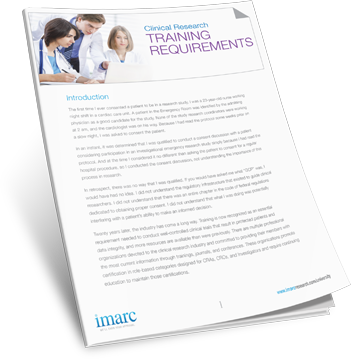
Clinical Research Training Requirements
Featured Resource

clinical research Training requirements

This whitepaper examines the similarities and differences between various US and international regulations and place them within the context of any number of roles found within the realm of clinical research.