
<img height="1" width="1" style="display:none" src="https://www.facebook.com/tr?id=213807269037206&ev=PageView&noscript=1">
IMARC Blog

Compliance In Focus

FILTER BY:

Newest Post

Michael Marotta

Recent Posts

Posted by Michael Marotta on Wed, Apr 25, 2018

IMARC Research Team to Present at ACRP

The annual ACRP meeting will be held this upcoming weekend (27-30 April 2018) at the Gaylord National Resort and Convention Center in National Harbor, Maryland. This meeting presents an opportunity for clinical research professionals to meet and listen to/discuss the latest in clinical research. At this meeting, IMARC will be presenting on Saturday, 27 April 2018, from 11:30-12:30 on the topic of adverse event (AE) reporting for medical device clinical trials.

Topics: ACRP Conference, Adverse Events, IMARC Research
Posted by Michael Marotta on Thu, Sep 28, 2017

IVD Basics

It has been estimated that In Vitro Diagnostics (IVD) will play a role in around 70% of health care decisions, and market estimates predict the IVD market will be close to 75 billion dollars in 2010. The role of IVDs in health care decisions should only continue to grow as healthcare shifts away from a “one-size-fits-all” model. Furthermore, developments in technology and the scope and precision of some of these devices have led to the evolution of the IVD field and with it, the role the FDA has played in regulating these devices.

Topics: In Vitro Diagnostics, FDA

Posted by Michael Marotta on Fri, Jan 15, 2016

What to do When New information is Presented?

On the eve of the day we welcomed 2016 the FDA issued a draft guidance regarding notification of the public on “emerging signals” regarding medical devices that are already used in clinical practice.  The FDA defined an emerging signal as “new information about a medical device” that:

  1. The Agency is monitoring or analyzing
  2. Has the potential to impact patient management decisions and/or alter the known benefit-risk profile of the device
  3. Has not been fully validated or confirmed
  4. For which the Agency does not yet have specific recommendations

Topics: Draft Guidance, FDA, Emerging Signals

Posted by Michael Marotta on Mon, Nov 06, 2017

Hear Ye, Hear Ye, This Meeting is Called to Order

This is the second of a two blog series on the Draft Guidance for Institutions and IRBs.  The first blog was published on January 7, 2016.

In November 2015, the Food and Drug Administration (FDA) and Office for Human Research Protections (OHRP) jointly issued a draft guidance to assist both institutions and institutional review boards (IRBs) in preparing and maintaining minutes of IRB meetings. The requirement for an institution or IRB to prepare and maintain adequate documentation of IRB activities can be found in the regulations (45 CFR 46.115; 21 CFR 56.115) and inadequate meeting minutes has shown up as a common deficiency in 2014 IRB inspections and Warning Letters. As a result, the draft guidance was prepared to provide recommendations on the type and amount of information to include in the minutes.

Topics: Draft Guidance, IRBs, FDA, Institutions

Posted by Michael Marotta on Fri, Jun 03, 2016

I’m Looking Through You… More Transparency for Clinical Trials?

Recently, the United States Department of Health and Human Services and the National Institute of Health (NIH) issued two proposed rulings that may have a profound impact on how results of clinical trials are made more transparent to the public.  However, before we discuss these proposals, we should discuss briefly how the public has access to clinical trials.

Topics: FDA, NIH, ClinicalTrials.gov, National Library of Medicine, Clinical Research

Posted by Michael Marotta on Wed, Mar 04, 2015

Compassionate Use and the Animal Rule

In March of 2014, we wrote about Compassionate use in Unapproved Medical Devices. To briefly summarize, compassionate use refers to the use of an unapproved device or drug in a single patient or small group where the condition of the patient/group is serious and there is no alternative treatment. The FDA can use regulatory discretion to determine if an investigational drug/device can be used and FDA approval is required prior to use.  This clause has come under the spotlight recently with the treatment of two American health care workers and a Spanish priest with an experimental drug, ZMapp, developed by the pharmaceutical company MAPP Pharmaceuticals. ZMapp is a serum-based drug that previously had not been clinically tested in humans.  It represents a number of drugs and vaccines that are currently being developed  to combat Ebola, a single-stranded RNA virus that is highly pathogenic with a fatality rate of up to 90%. According to the World Health Organization, as of 16 August 2014 there have been 2240 reported cases and 1229 deaths from this disease spanning four countries in West Africa (Guinea, Liberia, Sierra Leone, and Nigeria).

Topics: FDA, World Health Organization, Compassionate Use, Animal Rule, Ebola Virus

Posted by Michael Marotta on Tue, Aug 11, 2015

Personalized Medicine, the FDA, and Health Care Professionals

Recently we have reviewed the role of direct-to-consumer genetic testing  within the sphere of personalized medicine.  Personalized medicine can refer to tailoring disease treatment, therapy, or prevention to a particular individual, often utilizing some of the genomic signatures that make each of us unique.  Today we will look at a recent FDA news release which looks at personalized medicine from the perspective of the health care professional in respect to two areas: in vitro diagnostic (IVD) companion devices and laboratory developed tests (LDT).

Topics: Personalized Medicine, IVD, Laboratory Developed Tests, FDA

Posted by Michael Marotta on Mon, Nov 06, 2017

Keeping Track of Your Health 24/7

On August 5th we introduced the notion that there is an overwhelming abundance of information available at the fingertips of the consumer.  In Part One we took a closer look at the role of the FDA in Personalized Genomics and direct-to-consumer genetic tests. Now in Part Two we will take a closer look at the role of the FDA in regulating mobile medical applications.

Topics: FDA, Personalized Medicine, Mobile Medical Applications, 24/7

Posted by Michael Marotta on Mon, Jul 09, 2018

Wading in a Sea of DNA

On August 5, 2014 we introduced that the field of personalized medicine has grown rapidly and has encompassed both the field of genetic testing and mobile health apps.  Today we take a closer look at direct-to-consumer genetic testing.  It took thirteen years for the first draft of the human genome to be completed.  In the eleven years since this monumental accomplishment the field of genomics has grown exponentially.  And the fruits of this growth are multi-faceted: tests for disease association, risk, diagnosis, treatment; the list goes on and on.  However the implications for the results of these tests are far-reaching and have a direct affect on both the individual person and on the greater collective.  In the wake of this rapid development of genomic knowledge and increasingly more powerful computers and equipment capable of processing this information, many companies have formed to provide direct to consumer, relatively low cost personalized genomic information.  And with the creation of these companies, the FDA has taken a closer look at the information being disseminated to the consumer.

Topics: FDA, Personalized Medicine, DNA, 23andMe

Posted by Michael Marotta on Wed, Mar 04, 2015

We Have the Whole World in our Hands

The amount of information an individual has at their fingertips can be staggering. This can lead to a great deal of empowerment for the consumer in medical, consumer, and social interactions.  In the medical field, improvements in technology have led to a dramatic decrease in the cost to process and analyze an individual’s DNA which has resulted in an influx of genetic tests and information available to an individual. Furthermore, the prevalence of mobile devices/apps (including mobile health apps) has grown exponentially giving consumers an awe-inducing number of choices at the buffet of instant information. As one would expect, this rapid progression has not come without growing pains.  Both the FDA and the companies creating/providing this information have had to consistently re-evaluate how and if this content falls under the auspices of Federal Regulations.

Topics: FDA, Personalized Medicine, Personalized Genomics

Posted by Michael Marotta on Thu, Jul 19, 2018

38 Million Reasons to Improve Clinical Trials

On Friday, May 23, 2014 the Federal Register announced a notice that in an effort to increase the quality and efficiency of clinical trials, the Food and Drug Administration (FDA) was planning to grant a one-year, $7,500,000 grant to Duke University’s Translational Medicine Institute (DTMI) (renewable up to a total of five years, $37,500,000). This grant would primarily go to fund the public-private partnership Clinical Trials Transformation Initiative (CTTI).  CTTI  was originally created as a partnership between the FDA and Duke University in 2008, but now includes more than 60 organizations with representatives from government agencies, industry, patient advocacy groups, professional societies, investigator groups, academic institutions, and other interested parties.

Topics: FDA, Federal Register, Improve Clinical Trials

Posted by Michael Marotta on Thu, Jul 19, 2018

Pediatric Devices: One Size Does Not Fit All

Having a sick child can be one of the hardest jobs of parenting.  Having a sick child that requires treatment and care beyond a quick visit to the local doctor or nurse, or light fluids and lots of rest can cause the worry to rise exponentially.  And what if treatment involves a procedure involving an experimental medical device?  A recent guidance published by the FDA on March 24, 2014 attempts to clarify the department’s thinking on how to effectively protect the pediatric population.  This guidance comes after the FDA issued a finale rule on January 10, 2014 amending PMA regulations to require inclusion of information relating to pediatric subpopulations that suffer from the disease or condition that a device is intended to treat, diagnose, or cure, and the number of affected pediatric patients.  This guidance caps off a series of rules and guidance’s issued over the last 13 years when, in 2001, the FDA issued an interim rule to comply with the Children’s Health Act of 2000.  This interim rule mandated that all pediatric research in the US offer additional protections to ensure pediatric patient safety.

Topics: FDA, Pediatric Devices, Children’s Health Act of 2000

Posted by Michael Marotta on Mon, Nov 06, 2017

Should Sham Procedures Become a More Integral Part of Medical Device Trials?

Currently hypertension affects 30.4% of the American population and is projected to cost the nation 91.4 billion dollars a year in 2015.  A subset of hypertensive patients have what is referred to as resistant hypertension.  This refers to a patient receiving three or more anti-hypertensive medications without receiving adequate benefit.  Because of this arbitrary definition, the number of people afflicted with resistant hypertension has varied between 5% in general medical practice and 50% in nephrology clinics. As an alternative to additional anti-hypertensive medication, renal denervation has been used as a therapy to combat high blood pressure.

Topics: Renal Denervation, Sham Procedures, Clinical Research

requestconsult-bg.jpg
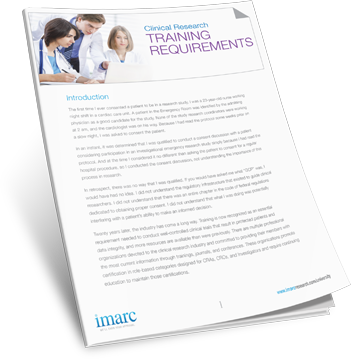
Clinical Research Training Requirements
Featured Resource

clinical research Training requirements

This whitepaper examines the similarities and differences between various US and international regulations and place them within the context of any number of roles found within the realm of clinical research.