

<img height="1" width="1" style="display:none" src="https://www.facebook.com/tr?id=213807269037206&ev=PageView&noscript=1">
IMARC Blog

Compliance In Focus

FILTER BY:

Newest Post

Tracey Tytko

Recent Posts

Posted by Tracey Tytko on Thu, Mar 02, 2017

5 Tips to Survive an FDA Inspection

You just got the phone call; the Food and Drug Administration (FDA) Inspector is coming for a visit.

Are you feeling calm and prepared, or like most people in your position, are you in some stage of panic? After all, who wants someone from the federal government looking for (and inspecting!) all the things you might have done wrong?

Don’t let anxiety get the best of you – begin preparing now.

Topics: FDA Inspection, FDA BIMO inspection
Posted by Tracey Tytko on Wed, Jan 03, 2018

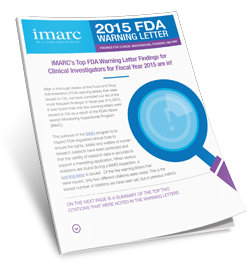
FDA Warning Letters: Findings for Clinical Investigators

Each year the Food and Drug Administration (FDA) releases metrics on the Bioresearch Monitoring (BIMO) Program. The purpose of the BIMO program is to inspect FDA-regulated clinical trials to ensure the rights, safety and welfare of human research subjects have been protected and that the validity of research data is accurate to support a marketing application. When serious violations are found during a BIMO inspection, a warning letter is issued. These BIMO inspection metrics provide the common findings that are found during these inspections by fiscal year (FY). According to the United States federal government, the FY begins on October 1st of the previous calendar year and ends on September 30th, the year in which it is numbered.

Topics: FDA Warning Letters, BIMO Program, FDA

Posted by Tracey Tytko on Fri, Jun 03, 2016

Attn: Data Integrity Compromised

After months/years of conducting your clinical trial, you submit a Premarket Approval Application (PMA) to the Food and Drug Administration (FDA) with the expectation that your Class III medical device will be approved. Unexpectedly, you receive a call from the FDA. The FDA requests to inspect one of your sites to ensure that the data is scientifically valid and the welfare of research subjects have been protected. You don’t worry. Later, the FDA issues a Warning Letter revealing serious violations that could jeopardize the validity of the trial and may refuse to approve the application. You then realize, all of this could have been prevented.

Topics: FDA, Data Integrity, Clinical Monitoring

Posted by Tracey Tytko on Tue, May 24, 2016

The World of Digital Health

We are in an era where mobile platforms, such as smartphones, tablets and wearable devices have become a necessity. Mobile applications that run on these platforms provide a variety of entertainment options (games, videos, etc.), allows you to check your electronic mail, and interact with family and friends. Other applications that are being developed are now allowing us to track our health and wellness, and even communicate with healthcare providers, remotely. These types of applications are known as either mobile health applications (mHealth) or mobile medical applications (MMAs).

Topics: Mobile Medical Applications, FDA, Digital Health,

Posted by Tracey Tytko on Mon, Nov 06, 2017

The Future of the FDA: The Perception of a Clinical Research Associate

There are many stakeholders involved in conducting a clinical trial today; however, there can be many challenges to the infrastructure of running a clinical trial. Challenges that are seen with running medical device trials can vary anywhere from securing funding to lacking time and having dedicated study personnel. Another challenge that is faced is the time to market new devices that are ensured to have safety, quality and effectiveness. Although protecting human research subjects is the top of all priorities, can this regulatory pathway be shortened?

Topics: FDA, CDRH, Robert Califf, Clinical Research Associate

requestconsult-bg.jpg
Clinical Research Training Requirements
Featured Resource

clinical research Training requirements

This whitepaper examines the similarities and differences between various US and international regulations and place them within the context of any number of roles found within the realm of clinical research.