IMARC Research continues to focus on being an industry thought leader through our whitepapers, infographics, speaking engagement and blogs. During 2014, IMARC Research continued this tradition by publishing content that help inform and education our industry.
Topics:
Thought Leadership,
Published Content,
IMARC Research
You may be familiar with IMARC Research’s History of Clinical Research (HCR). We recently released an eBook about it that briefly describes all of the images that currently make up the timeline. If you have visited our office, you may have also been given a guided tour of one of our most renowned resources. Due to the overwhelmingly positive feedback we have received, we will be highlighting each time point with a series of blogs that we plan to release over the course of the 2014-2015 calendar years.
Topics:
Nuremberg Code,
1947,
World War II
What is the difference between Significant Risk studies (SR) and Non-significant Risk studies (NSR)?
Topics:
Medical Devices,
Significant Risk,
Non-Significant Risk,
FDA
Currently, trial results for are only required to be submitted to the online database for cleared or approved devices. However, a November 19th proposal from the National Institutes of Health which would require trial results and descriptive information for devices and device indications that have yet to be cleared or approved by FDA would be posted on the public ClinicalTrials.gov website. The proposal would give trial sponsors up to three years between the completion of the trial and when results nee to be submitted to NIH if they are legitimately working towards reaching the market.
Topics:
NIH,
Unapproved Devices,
FDA ClinicalTrials.gov
Often, when one thinks of the team that actually brings a new medical device or drug to market, the first people that come to mind are those at the sponsor company and the investigators at the individual sites – the leaders of the study. What may be less known, though, is that often the study hinges on the shoulders of the Clinical Research Coordinator (CRC). Briefly, CRCs are responsible for the accurate maintenance of the records for the trial, as well as many parts of the trial that otherwise may be overlooked. Some of the major responsibilities of the CRC are:
Topics:
Clinical Research Coordinators,
Investigators,
Clinical Research,
IRB
Recently, the United States Department of Health and Human Services and the National Institute of Health (NIH) issued two proposed rulings that may have a profound impact on how results of clinical trials are made more transparent to the public. However, before we discuss these proposals, we should discuss briefly how the public has access to clinical trials.
Topics:
NIH,
ClinicalTrials.gov,
National Library of Medicine,
FDA,
Clinical Trials
In the clinical research industry approvals for investigational products are not granted- they are earned. With FDA and International inspections on the rise, so are stress levels of everyone involved in clinical studies. Auditing can be looked at as a quality improvement process, and a way to prepare for inspections and approval by:
Topics:
FDA Guidance,
Audits,
International Medical Device Regulators Forum
An article in “The Gray Sheet” recently caught my attention. It talked about how the recent takeover by the Republican Party in the Senate, along with an increase in GOP House seats, could lead to an increased oversight of the FDA.
Topics:
John Manthei,
Fred Upton,
21st Century Cures,
Margaret Hamburg,
FDA
Coming from a background of working as a patient care nurse in the ICU, I would witness the consent process on a daily basis for biopsies, bronchoscopies, chest tubes, arterial lines, etc... These were non-research procedures; they were procedures to assist in the treatment of the critically ill. When I first started a career in research, I already knew that obtaining consent was more than a piece of paper and that it was a discussion and a process, but “a consent is a consent” for standard treatment in a hospital or for research, right? WRONG- I found out very quickly through IMARC’s training program that obtaining consent in research involves so many different specific elements, different from an informed consent for non-research procedures.
Topics:
FDA,
Clinical Research,
IRB,
Consent,
21 CRF 50.25
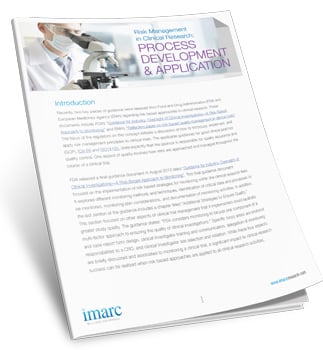
As the regulators continue to raise the bar for quality clinical research investigations, IMARC has released a new whitepaper that discusses the principles of risk management and their application to clinical research.
Topics:
Whitepaper,
Risk Management,
Guidance Document,
IMARC Research,
FDA