

<img height="1" width="1" style="display:none" src="https://www.facebook.com/tr?id=213807269037206&ev=PageView&noscript=1">
Blog

Compliance In Focus

remote services

LEARN MORE ABOUT REMOTE SERVICES

Keep Your Clinical Trial Moving from a Distance

You want to keep your trial on track, but physical distancing and travel restrictions have made it difficult. Fortunately, IMARC has experience providing remote services.

FILTER BY:

Newest Post

Posted by John Lehmann on Thu, Jan 05, 2017

ALCOA – A Tool to Document Your Work

When documenting your research observations, it is important to remember the adage, “If it wasn’t documented, it wasn’t done”. As research professionals, we have an obligation to uphold the highest ethical standards and make all possible efforts to comply with Good Clinical Practice. We must take credit for what we do - and to take credit for what we do, we must properly document our work.

Topics: ALCOA, ALCOA Checklist

Posted by Holly Whitta on Tue, Sep 27, 2016

Organization: The Master Key to Compliance

While good organizational skills may present a challenge to many of us, allowing disorder to follow us to work is simply a recipe for disaster. Not only can disorganization create for a hectic day, it can also lead to larger problems with industry compliance standards and FDA approvals. Whether your company is involved in drug trials or device studies, poor organization can leave your site more vulnerable to non-compliance if risk-based monitoring is used. It can also create an unpleasant environment during an FDA audit if there are issues with a Sponsor or site’s compliance with ALCOA (attributable, legible, contemporaneous, original, and accurate) guidelines. (Please refer to our ALCOA infographic for more information.)

Topics: ALCOA, Compliance, Organization

Posted by John Lehmann on Thu, Sep 22, 2016

ALCOA - The Best Way to Document Your Work

When documenting your research observations, it is important to remember the adage, “If it wasn’t documented, it wasn’t done”. As research professionals, we have an obligation to uphold the highest ethical standards and make all possible efforts to comply with Good Clinical Practice. We must take credit for what we do - and to take credit for what we do, we must properly document our work.

Topics: ALCOA, Checklist

Posted by John Lehmann on Wed, Mar 04, 2015

The Best Way to Document Your Work

When documenting your research observations, it is important to remember the adage, “If it wasn’t documented, it wasn’t done”. As research professionals, we have an obligation to uphold the highest ethical standards and make all possible efforts to comply with Good Clinical Practice. We must take credit for what we do - and to take credit for what we do, we must properly document our work.

Topics: Good Clinical Practice, Research Professionals, ALCOA, 21 CFR 58.130 (15)

Posted by John Lehmann on Wed, Mar 04, 2015

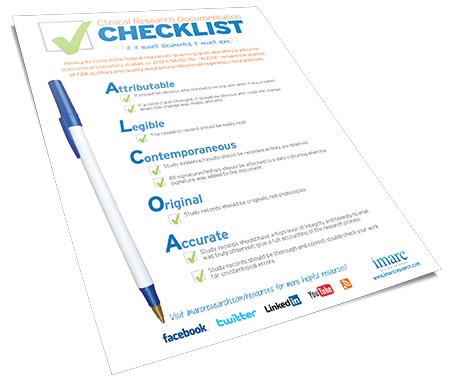
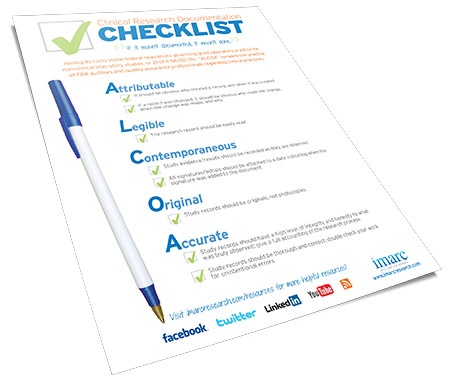
The Clinical Research Documentation Checklist

Good Clinical Practice is the cornerstone for conducting clinical studies. However, as clinical research professionals we should strive to take “good” to “great”. This requires having historical perspective and a firm understanding of GCP requirements, but it is equally important to know how to properly document authentic research observations.

Topics: Good Clinical Practice, ALCOA, 21 CFR 58.130 (15)

Posted by John Lehmann on Wed, Mar 04, 2015

What Makes a Good Monitor?

Well it’s no secret that our industry is a fan of acronyms. Acronyms are widely used as helpful mnemonic devices to remember important or useful information. And, let’s face it- from examples like ALCOA to FAIR Shake, they’re just too good to stop using! Here’s another to add to the list that revolves around monitors.

Topics: ALCOA, Good Monintor, FAIR Shake, Acronyms

Posted by John Lehmann on Wed, Mar 04, 2015

The Best Way to Document Your Work

When documenting your research observations, it is important to remember the adage, “If it wasn’t documented, it wasn’t done”. As research professionals, we have an obligation to uphold the highest ethical standards and make all possible efforts to comply with Good Clinical Practice. We must take credit for what we do - and to take credit for what we do, we must properly document our work.

Topics: Good Clinical Practice, ALCOA, Document Your Work