

<img height="1" width="1" style="display:none" src="https://www.facebook.com/tr?id=213807269037206&ev=PageView&noscript=1">
Blog

Compliance In Focus

remote services

LEARN MORE ABOUT REMOTE SERVICES

Keep Your Clinical Trial Moving from a Distance

You want to keep your trial on track, but physical distancing and travel restrictions have made it difficult. Fortunately, IMARC has experience providing remote services.

FILTER BY:

Newest Post

Posted by John Lehmann on Fri, Jun 03, 2016

Top 10 Tips- Get the Most Out of Your Clinical Trial Imaging

In clinical research having a well-run, compliant study is a top priority. Ensuring patients are protected and resulting data has integrity, it’s important to be experts in all aspects of your study. If your trial involves imaging, understanding how to get the most out of your data is not only smart- it’s cost effective. From a recent article published on GEN - Genetic Engineering & Biotechnology news, here are nine tips to help bring products to market faster with these ways of optimizing preclinical imaging:

Topics: ImageIQ, Top 10 Tips, IMARC Research, Clinical Research

Posted by John Lehmann on Wed, Mar 04, 2015

Friday Fun: What Motivates YOU in Clinical Research?

Recently we sent out a tweet asking this simple question: What Motivates YOU in Clinical Research? We were excited to see this answered, and retweeted by those in our industry.

Topics: GCP/Regulatory Training, IMARC Research, Clinical Research

Posted by Sandra Maddock on Fri, Jun 03, 2016

4 Barriers to Recruitment in Clinical Trials

It’s an unfortunate reality in clinical research; Oftentimes sites struggle to recruit subjects.  Frustration trickles down from the principle investigator and on down to the coordinators as sponsors put pressure on sites to enroll, enroll, enroll.  What are the barriers to recruitment and how can they be overcome?

Topics: Recruitment, Clinical Subjects, Clinical Research

Posted by John Lehmann on Fri, Jun 03, 2016

Inept Clinical Trial Endpoints Can Cost Billions

Here’s a staggering statistic for you- inefficient clinical trials are costing some companies between $4 and $6 billion each year in unnecessary expenses. This is according to study data published by the Tufts Center for the Study of Drug Development (CSDD).

Topics: RAPS, Tufts Center for Study of Drug Development, Clinical Research

Posted by Brandy Smith on Wed, Mar 04, 2015

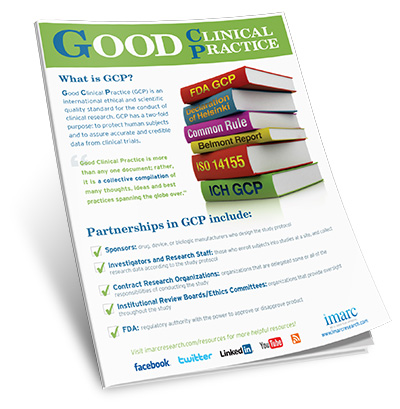
GCP… What Does it Mean?

Do you know why rules, regulations and standards exist? What exactly is Good Clinical Practice and how does this help protect patients and data integrity?

Topics: Good Clinical Practice, Infographic, Clinical Research

Posted by John Lehmann on Fri, Jun 03, 2016

How Do We Regain Society’s Confidence in Clinical Trials?

We live in a fast-paced world; a world where new technology and innovation develops in rapid succession.  We are always seeking the “latest and greatest” in technology.  Intertwined in this world of technology and innovation, lies the world of clinical research.  People who are ill or disease-ridden have faith and hope that a miracle cure or life saving device is just around the corner.  But what happens when society as a whole loses faith in clinical research?  Who will volunteer for research studies when trust in the system fails?

Topics: Subject Protection, Clinical Research

Posted by Sandra Maddock on Wed, Mar 04, 2015

Why Use an Integrated EDC/EHR System in Clinical Research?

Being a CRO that specializes in helping companies gain FDA and world-wide approval through monitoring, auditing, training and consulting services- it’s fair to say we’ve come across a wide range of fellow CROs, investigative sites, research teams, and hospital systems. It’s amazing how much innovation exists- not just with the investigative products- but with technological advances to platforms used the healthcare industry.

Topics: CRO, Integrated EDC/EHR System, Clinical Research

Posted by John Lehmann on Wed, Mar 04, 2015

How Medical Device Development Is Different

Each sector of the research industry faces its own unique challenges. For instance, take clinical research involving drugs versus devices. While some aspects of the research process and clinical trial are the same, their differences require special attention to have a compliant and well-controlled study. Likewise, an article titled, “Combating the challenges of medical device development,” investigates how medical device development is similar to other product development- but still faces unique challenges.

Topics: Medical Device Development, Drugs versus Devices, Clinical Research

Posted by John Lehmann on Mon, Jul 09, 2018

Muscular Dystrophy Association: "Cuff her, Dano"

With all due respect to this iconic Hawaii5-0 quote, an interesting thing happened recently at work, IMARC’s CEO Sandra Maddock was taken away in handcuffs!  Check out IMARC's Facebook page for pictures of our jail-bird being “arrested”.  Not such an unusual story in todays post-ENRON world, but this “arrest warrant” involved raising “bail money” for the Muscular Dystrophy Association’s “2012 West Cleveland Executive MDA Lock-Up™”.   The Muscular Dystrophy Association (MDA), nationally headquartered in Tucson, AZ is the largest non-governmental sponsor of research investigating the causes of and effective treatment for neuromuscular diseases.

Topics: Sandra Maddock, Muscular Dystrophy Association, Clinical Research

Posted by Brandy Smith on Fri, Jun 03, 2016

How Can You Bolster Clinical Trial Enrollment?

Your site is weeks past study initiation and all the candidates that you expected to be screening for the study have not materialized.  Would trial-related advertising or recruitment materials enhance your sites' enrollment efforts? 

Topics: 21 CFR Part 56, FDA, Clinical Research

Posted by Sandra Maddock on Thu, Jul 19, 2018

Is HIPAA Cost Effective in Clinical Research?

A new report was published by the Institute of Medicine (IOM), which outlines ten recommendations to achieve a better health care system. The report, “Best Care at Lower Cost- The Path to Continuously Learning Health Care in America,” touched on elements that directly influence our industry. The ten recommendations fell into three main categories:

Topics: Institute of Medicine, Clinical Research, HIPAA

Posted by Jennifer Wiley on Fri, Jun 03, 2016

Should Texting be Encouraged in Clinical Communications?

Texting to communicate when a telephone call or email is otherwise not possible provides immediate delivery and may offer an advantage over some other means of communication.  In an article by mHIMSS, the American wireless industry leads the world in overall value, innovation and investment.  As such, it’s safe to say that American consumers use their mobile products and services more than any others in the world.  SpyGlass consulting group found that 94 percent of all physicians in the country are using a smartphone at work.  Texting at work might even make staff members more productive, by sending or receiving a short text message to check on a patient’s status rather than engaging in a lengthy phone conversation. In clinical trails, text messaging technology is sometimes used to measure the success or failure of treatment for subjects in research.

Topics: Texting, Clinical Communications, Clinical Research

Posted by John Lehmann on Fri, Jun 03, 2016

Should We Use Social Media to Recruit Study Subjects?

The growth of social media over recent years has been astounding. Just take a look at the figures  : In 2005, only 5% of American adults used social media, six years later the percentage had grown to 50%, and this number continues to rise. So how is our industry reacting to this new trend?

Topics: social media, Recruitment, Clinical Research

Posted by Brandy Smith on Fri, Jun 03, 2016

Dangerous Clinical Trial Loophole?

The question of the day: Should sponsors be required to publish results of clinical trials for the public to view? A new bill proposed to the US House of Representatives would require this action. The bill titled “Trial and Experimental Studies Transparency Act of 2012” or the “TEST Act” for short, hopes to further human subject protection by ensuring disclosure of additional information surround a clinical trial.

Topics: Trial and Experimental Studies Transparency Act of, Congressmen Edward Markey, Clinical Research

Posted by Jennifer Wiley on Fri, Jun 03, 2016

Working in Clinical Research and Being a Research Volunteer

As those of us who work in clinical research know, there’s always another study that needs volunteers and never enough volunteers for that study.  If you’re wanting to volunteer for a study, you can always check out ClinicalTrials.gov for information about current studies worldwide.  This site is a registry and results database for federally and privately supported clinical trials.  This site, developed by the National Institutes of Health, was designed to provide valid and correct information about clinical studies.

Topics: Research Volunteer, Clinical Research

Posted by Sandra Maddock on Wed, Mar 04, 2015

How Important is a Clinical Research Coordinator?

Often, when one thinks of the team that actually brings a new medical device or drug to market, the first people that come to mind are those at the sponsor company and the investigators at the individual sites – the leaders of the study.  What may be less known, though, is that often the study hinges on the shoulders of the Clinical Research Coordinator (CRC).  Briefly, CRCs are responsible for the accurate maintenance of the records for the trial, as well as many parts of the trial that otherwise may be overlooked.  Some of the major responsibilities of the CRC are:

Topics: Informed Consent, Monitor, Clinical Research, IRB

Posted by John Lehmann on Wed, Mar 04, 2015

Going Green in Clinical Research Trials

In the movement to “go green” and reduce overhead, some clinical sites are moving away from printing every piece of correspondence regarding a research study.  While this may reduce the cost for printer/paper toner, not to mention the time to print and file all correspondence, is this a wise decision?

Topics: Monitors, Going Green, Clinical Research, Regulations

Posted by John Lehmann on Fri, Jun 03, 2016

CRA Retention: Four Tips to Consider

As questioned in this issue of the Journal of Clinical Research Best Practices - why does the clinical research industry have such a high turnover rate for clinical research personnel?

Topics: CRA Retention, Clinical Research, Clinical Monitoring

Posted by John Lehmann on Wed, Mar 04, 2015

Four Points to Consider in Global Clinical Trials

I came across a recently published article, “Clinical Trials Have Gone Global: Is This a Good Thing?” published by Lang and Siribaddana. The title immediately caught my attention and begs the question: why is there a trend of clinical trials going over seas, and what are the possible consequences? The paper is divided sub-headings that pose the following enquiries:

Topics: Global Clinical Trials, FDA, Clinical Research

Posted by John Lehmann on Fri, Jun 03, 2016

From Clinical Research Coordinator to Monitor

This blog was written by a newer monitor with IMARC Research.  This is her experience, and certainly not representative of all research coordinators and monitors.  We thank her for sharing this, and hope others who have made the similar transition will chime in with their experiences!

Topics: Federal Regulations, Clinical Research, Clinical Monitoring

Posted by John Lehmann on Wed, Mar 04, 2015

Clinical Research: The To-Do List Goes On and On….

Everyone has a “To-Do” List or lists; Things to do at work, at home, during the week, on the weekends, sometimes even on vacations.  To-do lists pile up and add up.  Just when you think that your list may be shortening, more to-do’s get added on or new lists are started.

Topics: Coordinators, To-Do List, Clinical Research

Posted by John Lehmann on Fri, Jun 03, 2016

Are Clinical Trials Providing Too Little Information?

The NY Daily News recently published an article which suggests that our industry is falling short in the realm of clinical trials. The article focuses on a report from the Journal of the American Medical Association that was conducted by the FDA and top leaders at Duke University. The objective, as stated in the abstract, was to “examine fundamental characteristics of interventional clinical trials registered in the ClinicalTrials.gov database.”

Topics: National Database, FDA, Clinical Research

Posted by John Lehmann on Fri, Jun 03, 2016

Five Points to Consider When Choosing a CRO

For a sponsor or investigator, selecting the right Clinical Research Organization (CRO) to help with the monitoring and management of a clinical trial can be crucial to a successful outcome.

Topics: Choosing a CRO, Clinical Research

Posted by John Lehmann on Fri, Jun 03, 2016

Monitoring: A Risked-Based Approach Day-to-Day

Oftentimes when one thinks of clinical trial monitoring, he thinks of a monitor making periodic site visits to the hospital or institution where the trial is taking place.  During these visits, the monitor verifies the data collected with the site’s source data and study documentation, among other duties.  These periodic site visits are often scheduled and made on an elapsed duration.  For example, some sponsors/studies require a monitor to be on site every 4-6 weeks to keep tabs on the data.  Seems like a pretty straightforward, streamlined, routine process, right?

Topics: Clinical Research, Clinical Monitoring

Posted by John Lehmann on Fri, Jun 03, 2016

Shortened Informed Consent Form

I recently came across this article describing the benefits to having a shortened informed consent form. As a monitor who has had experience with reviewing informed consents, as well as a former research coordinator who has obtained consent from study participants, I have mixed feelings on the topic.

Topics: Informed Consent, Clinical Research

Posted by John Lehmann on Wed, Mar 04, 2015

Documentation in Device Studies: Proving Patient Protection

Please take time to download IMARC's most recent white paper, written by Brandy Smith, Chief Clinical Officer for IMARC.  In summary, regulations that govern clinical research were put in place to protect clinical research subjects, and during FDA inspection, the extent to which a clinical researcher complied with those regulations – or protected patients – will come under scrutiny. If in doubt about the appropriate documentation practices, read though the regulations in question and think to yourself, how can I document my compliance with the regulation?    Oftentimes we make decisions in order to meet the regulations, but neglect to take that extra step to document our actions. If someone was to review your work, would it be clear that the regulations were followed?  The patients protected?  Please take time to review and let us know what you think.

Topics: brandy smith, FDA, Clinical Research

Posted by John Lehmann on Fri, Jun 03, 2016

Stem Cell Fraud

CBS recently revisited an important consumer health topic – the misrepresentation of stem cell treatments on the internet. In the 60 Minutes investigation, Dr. Joanne Kurtzberg of Duke University comments that there are ‘huge dangers’ of injecting unregulated stem cell treatments into a patient’s blood or spinal fluid because “little fragments and debris would get trapped somewhere in the blood stream and could cause a stroke, or in the brain [they] could cause an inflammatory reaction.” You can read the transcript here, and find the videos from the previous installments of the story from 2010 here and here.

Topics: john lehmann, Monitors, Clinical Research

Posted by John Lehmann on Fri, Jun 03, 2016

Ensuring Proper Protections for Vulnerable Research Subjects

The Code of Federal Regulations define vulnerable research subjects, and how those vulnerable subjects should be protected. 21 CFR 50.53 describes the circumstances under which children may participate in an investigation involving greater than minimal risk and no prospect of direct benefit . In order for these subjects to participate in clinical research trials, it is the researcher’s duty to ensure that these special protections are respected. It is unimaginable that these federally mandated laws and regulations could be discounted and ignored.

Topics: john lehmann, Clinical Research, IRB

Posted by John Lehmann on Thu, Jul 19, 2018

Have You Been Asked to Provide Vendor Credentials?

Today there is no national standard for the competence or credentials of healthcare vendors. There is no specific requirement for licensure, certification, registration, or education of healthcare vendors. However, the Joint Commission recognizes a few standards that affect anyone who may directly impact the quality and safety of patient care. Clinical monitors are not directly involved in patient care, but we can have impact on the safety and quality of the care of patients being treated in clinical research trials. In fact, GCP is our standard for ensuring data is accurate and credible and that trial subjects are protected from harm. Because of this influence, some healthcare institutions are considering monitors as healthcare vendors. Thus we are faced with the same dilemma the pharmaceutical and medical device representatives are dealing with at this time – vendor credentialing.

Topics: john lehmann, Monitors, Clinical Research

Posted by John Lehmann on Wed, Mar 04, 2015

A Monitor’s New Years’ Resolutions

  1. I will not complain when my travel plans are disrupted.
    Too loudly.
    To strangers.
    Except I will start complaining loudly to you, sir to my left, who is under the impression that he has purchased my seat as well as his own.
  2. I will not get frustrated when I don't get an immediate reply to an e-mail.
    I realize that the study I have e-mailed for information about is only one of a dozen studies that the Research Coordinator is responsible for, in addition to her clinic hours, in her part-time position with the site. I realize that the in-house contact is fielding questions from fourteen sites and the Project Manager and Regulatory Affairs and Clinical Safety, and even still she usually manages to respond to me within the hour. I realize that the world does not revolve around the fact that I leave for the airport in fifteen minutes.
  3. I will show my appreciation for the contributions made by the Research Coordinator.
    He has a million other things to do, and yet he clears off his desk so that I can have a comfortable place to work. He offers me coffee and shows me where the bathroom is and runs all the photocopies I request. He shows incredible grace and understanding when I enter query after query in his hard work. And after I deconstruct his hard work, he welcomes me back in two months for another visit. The least I can do is send an e-mail after our visit to thank him for his efforts.
  4. I will be more productive during my travel time – but I will think twice before writing a report on the redeye back from the West Coast.
    I know from experience and way too much time spent on edits that sometimes it’s just not worth it. 
  5. I will ask study staff at each site, How can I help make this better?
    Because no matter how overwhelmed a site is, because no matter how experienced and organized a coordinator is – there is something I can do to help make things run just a little more smoothly, and I’m genuinely happy to help in any way I can.

Here's to science and success in the New Year!

Topics: Clinical Research

Posted by John Lehmann on Fri, Jun 03, 2016

Gender Guidance

Recently the FDA issued a draft guidance on the study and evaluation of gender differences in medical device clinical studies. The guidance is issued with hopes to increase the number of female subjects enrolled in clinical trials.

Topics: Medical Devices, john lehmann, Clinical Research

Posted by John Lehmann on Fri, Jun 03, 2016

The Note-to-File Magic Eraser

It is not unusual for a monitor to come across upwards of a dozen Notes-to-file at a monitoring visit. At some sites it can seem as though the art of the Note-to-file is perfected as a Magic Eraser with regard to explaining away regulatory discrepancies. The regulatory purist in me shudders at this practice; but at my last monitoring visit, I stepped out of my normal comfort zone and recommended that my site staff colleagues compose several Notes-to-file to document resolution efforts that would otherwise be doomed to follow-up item purgatory. A Note-to-file should not be the immediate solution to a nagging regulatory issue, but there are several instances that can elevate this documentation tactic to preferred status.

Topics: john lehmann, notes-to-file, Clinical Research

Posted by John Lehmann on Wed, Mar 04, 2015

Partnering for an Improved Process

The process of obtaining approval for new medical devices can be a long and windy road.  This complicated and sometimes confusing process may soon get a little easier, according to an Industry News press release.

Topics: john lehmann, life science, Clinical Research

Posted by John Lehmann on Fri, Jun 03, 2016

FDA Issues Two Draft Guidance Documents

On November 10th, a FDA press release announced they issued a draft guidance aimed at fostering early-stage devices within the U.S.  The guidance contains new approaches toward early feasibility studies, which are conducted in a small number of patients early in device development, while providing appropriate human subject protection.  The FDA is seeking a small number of companies that could pilot the new approach, as the results of the pilot will help inform the final guidance.

Topics: Medical Devices, john lehmann, FDA, Clinical Research