

<img height="1" width="1" style="display:none" src="https://www.facebook.com/tr?id=213807269037206&ev=PageView&noscript=1">
Blog

Compliance In Focus

remote services

LEARN MORE ABOUT REMOTE SERVICES

Keep Your Clinical Trial Moving from a Distance

You want to keep your trial on track, but physical distancing and travel restrictions have made it difficult. Fortunately, IMARC has experience providing remote services.

FILTER BY:

Newest Post

Posted by Katelyn Weed on Tue, Aug 11, 2020

2018 FDA Warning Letters: Common Deficiencies

Each year, the FDA publishes its Bioresearch Monitoring (BIMO) metric findings to provide insight on audit trends and significant violations. The BIMO program’s inspectional data includes Clinical Investigative Sites, Institutional Review Boards (IRBs), Sponsors/Monitors, Contract Research Organizations CROs), Bioequivalence, and Good Laboratory Practice Audits.

Topics: BIMO Metrics, FDA Warning Letters

Posted by Katelyn Weed on Tue, Aug 11, 2020

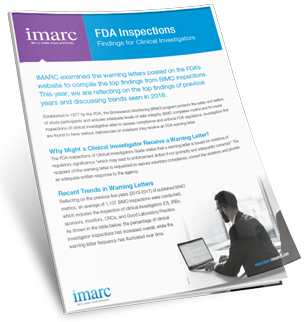
FDA Inspections: Findings for Clinical Investigators

=As we have done in past years, IMARC examined the warning letters posted on the FDA’s website to compile the top findings from BIMO inspections. This year, we are reflecting on the top findings of previous years and discussing trends seen in 2018.

Topics: FDA Warning Letters, BIMO Program, FDA Inspections

Posted by John Lehmann on Thu, Sep 27, 2018

Don’t Make These Mistakes In Your Clinical Trial: The Most Common FDA Violations


The FDA’s Bioresearch Monitoring (BIMO) inspection program ensures the protection of the rights, safety and welfare of human subjects during clinical research trials.

The most recent results represent findings from more than 1,300 clinical research audits of clinical investigators, sponsors and IRBs for the 2017 fiscal year.

This whitepaper covers the seven most common ones and how you can avoid them.

Topics: FDA Warning Letters

Posted by Elizabeth Braschayko on Thu, Sep 14, 2017

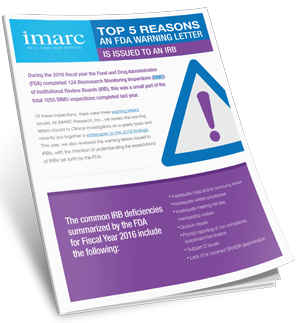
Top 5 Reasons an IRB Receives An FDA Warning Letter

Institutional Review Boards (IRBs) review clinical investigations that the FDA regulates, but the system of checks and balances goes both ways. The FDA has established regulations regarding IRB oversight, which are intended to protect the rights and welfare of human subjects. The FDA conducts inspections to ensure IRBs comply with these regulations and may issue warning letters for a variety of reasons.

Topics: FDA Warning Letters

Posted by Elizabeth Braschayko on Mon, Jul 09, 2018

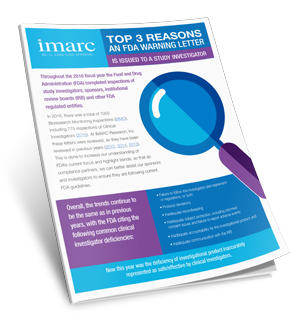
2016 FDA Warning Letters: Findings for Clinical Investigators

Each year the Food and Drug Administration (FDA) releases metrics on the Bioresearch Monitoring (BIMO) Program. The purpose of the BIMO program is to inspect FDA-regulated clinical trials to ensure the rights, safety and welfare of human research subjects have been protected and that the validity of research data is accurate to support a marketing application.

Topics: FDA Warning Letters, 2016, Clinical Investigators

Posted by John Lehmann on Wed, Jan 03, 2018

10 Keys For Responding to an FDA Warning Letter or Form 483

Each year, IMARC releases a whitepaper listing of the top reasons for FDA warning letters, here is the listing for 2015. Provided below are 10 Tips to consider when responding to a FDA Warning Letter or Form 483: 

Topics: Form 483, FDA Warning Letters

Posted by Tracey Tytko on Wed, Jan 03, 2018

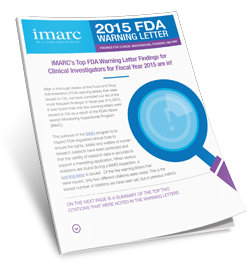
FDA Warning Letters: Findings for Clinical Investigators

Each year the Food and Drug Administration (FDA) releases metrics on the Bioresearch Monitoring (BIMO) Program. The purpose of the BIMO program is to inspect FDA-regulated clinical trials to ensure the rights, safety and welfare of human research subjects have been protected and that the validity of research data is accurate to support a marketing application. When serious violations are found during a BIMO inspection, a warning letter is issued. These BIMO inspection metrics provide the common findings that are found during these inspections by fiscal year (FY). According to the United States federal government, the FY begins on October 1st of the previous calendar year and ends on September 30th, the year in which it is numbered.

Topics: FDA Warning Letters, FDA, BIMO Program

Posted by John Lehmann on Mon, Jul 09, 2018

A Question of Disclosure: FDA Findings and Publications

When the Food and Drug Administration (FDA) identifies significant findings with the conduct of a clinical trial during an inspection, what happens to those findings? According to a article published online by JAMA Internal Medicine, those findings remain hidden in plain sight.

Charles Seife, MS, a professor at the Arthur L. Carter Institute of Journalism at New York University, conducted a research study that sought to “identify published clinical trials in which an FDA inspection found significant evidence of objectionable conditions or practices, to describe violations, and to determine whether the violations are mentioned in the peer-reviewed literature.”

Topics: Charles Selfe, FDA Warning Letters, FDA Inspection

Posted by Lauren Easley on Wed, Jan 03, 2018

2013 Top FDA Warning Letter Findings

For the fifth year, IMARC has searched through the warning letters posted on the FDA’s website to compile a list of the top findings for clinical investigators. This year, we noted twelve warning letters that were issued in 2013. In the past years, the most common citings tend to revolve around failure to follow the clinical investigational plan, insufficient recordkeeping, and inadequate subject protection. Interested to see if the trends continued for 2013?

Topics: Sponsors, FDA Warning Letters, IRBs, IMARC Research

Posted by Brandy Chittester on Wed, Mar 04, 2015

Is a Worksheet Adequate as Source Documentation?

In a perfect world, all the data needed to complete a clinical trial case report form would be found in the medical record. Unfortunately, we do not live in a perfect world!

Topics: ICH GCP, FDA Warning Letters, Worksheet, Source Documentation

Posted by Sandra Maddock on Wed, Mar 04, 2015

“If it is not documented, it was not done”

Topics: 21 CFR 812.140, Source Documents, FDA Warning Letters

Posted by Sandra Maddock on Thu, Jul 19, 2018

Financial Disclosure – 21 CFR 54 in a Nutshell

When conducting clinical trials, it is of utmost importance that the data generated be free from threats to the validity and integrity of the research. As demonstrated in many FDA warning letters, a commonly cited source of bias in clinical research can be found in the financial ties between investigators and sponsors. It is not unusual for the innovations of individual physician investigators to receive research and development funding from larger organizations that possess the resources to bring these innovations to market, and under 21 CFR 54, it is the responsibility of sponsors to collect for each investigator who is not a full-or part-time employee either a certification of no financial conflict of interest (Form FDA 3454), or a disclosure of the financial arrangements between the sponsor and investigator (Form FDA 3455). These financial disclosures must be updated by the investigators if there are any changes in financial disclosure status throughout the study, until one year after the study is completed.

Topics: 21 CFR 54, Financial Disclosure, FDA Warning Letters

Posted by Jacqui Lingler on Wed, Mar 04, 2015

Top 10 “Do NOT” Tips for FDA Responses

This week is FDA Warning Letter Week at IMARC!  Did you check out the first blog in a series of 4 titled Differences and similarities between FDA Warning Letters and Form 483s? Next learn the Top 10 “Do NOT” tips when responding to an FDA Warning Letter or Form 483:

Topics: Form 483, FDA Warning Letters, FDA Responses

Posted by John Lehmann on Wed, Jan 03, 2018

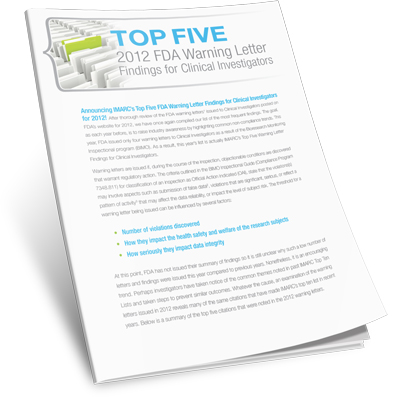
Top 5 FDA Warning Letters for 2012

Our annual report announcing the Top 5 Warning Letter Findings for Clinical Investigators for 2012 is hot off the press! Take the time to download and read IMARC’s newest whitepaper “2012 Top 5” list. This list is not intended to point fingers at investigators, but rather, to document the non-compliance trends in an effort to raise industry awareness of improvement needed. Whether you are a sponsor, a monitor, or an investigative site, everyone has a stake in the outcome of an FDA BIMO inspection.

Topics: Non-Compliance, 2012, FDA Warning Letters

Posted by Sandra Maddock on Wed, Mar 04, 2015

“If it is Not Documented, It Was Not Done”

Topics: 21 CFR 812.140, Documentation in Device Studies, Source Documents, FDA Warning Letters

Posted by John Lehmann on Wed, Mar 04, 2015

Financial Disclosure – 21 CFR 54 in a Nutshell

When conducting clinical trials, it is of utmost importance that the data generated be free from threats to the validity and integrity of the research. As demonstrated in many FDA warning letters, a commonly cited source of bias in clinical research can be found in the financial ties between investigators and sponsors. It is not unusual for the innovations of individual physician investigators to receive research and development funding from larger organizations that possess the resources to bring these innovations to market, and under 21 CFR 54, it is the responsibility of sponsors to collect for each investigator who is not a full-or part-time employee either a certification of no financial conflict of interest (Form FDA 3454), or a disclosure of the financial arrangements between the sponsor and investigator (Form FDA 3455). These financial disclosures must be updated by the investigators if there are any changes in financial disclosure status throughout the study, until one year after the study is completed.

Topics: 21 CFR 54, Financial Disclosure, FDA Warning Letters

Posted by John Lehmann on Wed, Jan 03, 2018

Top 10 2011 FDA Warning Letter Findings for Clinical Investigators

After reviewing warning letters issued to investigators and sponsor-investigators last year, through FDA’s Bioresearch Monitoring Inspection Program, IMARC’s clinical monitoring team has assembled the 2011 “TOP 10” list. This list is not intended to point fingers at investigators, but rather, to document the non-compliance trends in an effort to raise industry awareness of improvement needed. Whether you are a sponsor, a monitor, or an investigative site, everyone has a stake in the outcome of an FDA BIMO inspection.

Topics: Sponsor-Investigators, FDA BIMO inspection, FDA Warning Letters