


<img height="1" width="1" style="display:none" src="https://www.facebook.com/tr?id=213807269037206&ev=PageView&noscript=1">
Blog

Compliance In Focus

remote services

LEARN MORE ABOUT REMOTE SERVICES

Keep Your Clinical Trial Moving from a Distance

You want to keep your trial on track, but physical distancing and travel restrictions have made it difficult. Fortunately, IMARC has experience providing remote services.

FILTER BY:

Newest Post

Posted by Toni Hegyi on Thu, Nov 14, 2019

Answers to Your GCP Questions Made a Little Easier

No matter where you land on the clinical research spectrum, chances are you have encountered some challenges with interpreting and/or implementing Good Clinical Practice (GCP) guidelines. With so many trial designs and research settings, it can be difficult to know how to appropriately apply GCP and even more difficult at times to get answers.

To help with your search, the FDA has created a page that provides copies of e-mail messages (the original inquiry and associated reply(ies)) that have been submitted by the public to the Good Clinical Practice Program’s [email protected] e-mail account. Inquiries range from 2013 to 2018 and are categorized by the following inquiry subjects:

Topics: Good Clinical Practice, GCP, FDA

Posted by Heather S. Friar on Wed, Sep 04, 2019

Data Integrity is Important for the Success of Clinical Trials


Data integrity is a fundamental requirement of medical research and laboratory experimentation. All studies should be conducted according to the protocol guidelines and documented accurately and completely even if the data disproves or challenges the posted hypothesis. As researchers, it is our responsibility to make sure the study is conducted ethically and honestly. The results of the study are used to justify the effectiveness of a procedure, medical device or pharmaceutical. The goal is to improve the overall health and welfare of humans. Lack of data integrity could prove to be a disaster as something originally thought to be safe could cause unexpected pain or death.

Topics: Good Clinical Practice, The FAIR Shake, Data Integrity

Posted by John Lehmann on Thu, Mar 14, 2019

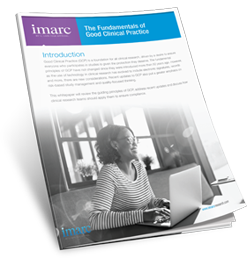
The Fundamentals of Good Clinical Research

ood Clinical Practice (GCP) is a foundation for all clinical research, driven by a desire to ensure everyone who participates in studies is given the protection they deserve. The fundamental principles of GCP have not changed since they were introduced more than 50 years ago. However, as the use of technology in clinical research has evolved to include electronic signatures, records and more, there are new considerations.

Topics: Good Clinical Practice, Clinical Research, IMARC Research Whitepaper

Posted by John Lehmann on Tue, Jan 08, 2019

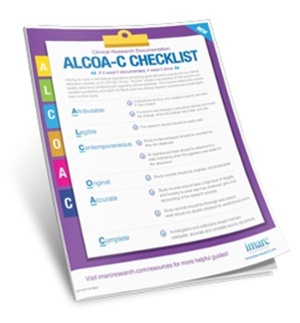
ALCOA-C Checklist for Download

Clinical research professionals have an obligation to uphold the highest ethical standards and make all possible efforts to comply with Good Clinical Practice. Proper documentation is of the upmost importance in our work!

Topics: Good Clinical Practice, ALCOA-C Checklist

Posted by John Lehmann on Tue, Oct 24, 2017

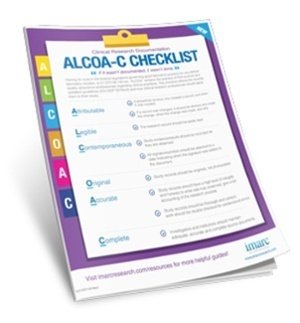
Clinical Research Documentation - ALCOA-C

As research professionals, we have an obligation to uphold the highest ethical standards and make all possible efforts to comply with Good Clinical Practice. We must take credit for what we do - and to take credit for what we do, we must properly document our work.

Topics: Good Clinical Practice, ALCOA-C

Posted by John Lehmann on Thu, Jul 19, 2018

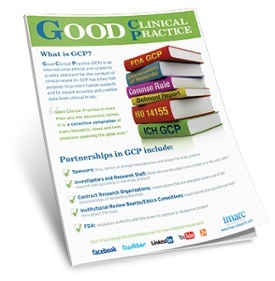
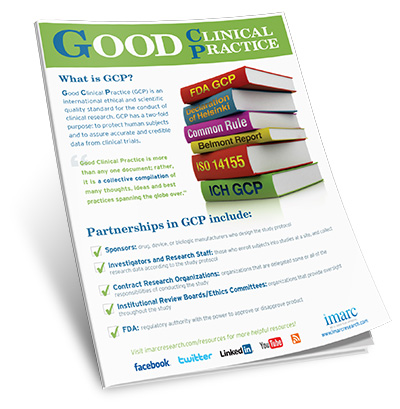
What is Good Clinical Practice?

Do you know why rules, regulations and standards exist? What exactly is Good Clinical Practice and how does this help protect patients and data integrity?

Protecting patients is at the core of clinical research and one of the ways research teams can ensure human subjects are protected is through holding up rules, regulations and standards set forth. Good clinical practice (GCP) is something that encompasses all these things because it is:

Topics: Good Clinical Practice, Human Subject Protection

Posted by John Lehmann on Thu, Jul 19, 2018

GCP - What Does it Mean?

Do you know why rules, regulations and standards exist? What exactly is Good Clinical Practice and how does this help protect patients and data integrity?

Topics: Good Clinical Practice, Infographic, Clinical Research

Posted by John Lehmann on Mon, May 23, 2016

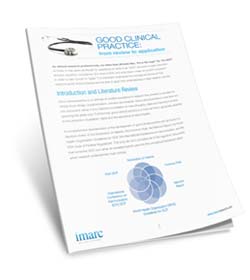
Good Clinical Practice: From Review to Applications

In clinical research many rules and regulations exist to govern the way research is conducted and to protect those patients who are participating in research. One of the standard principles directing clinical research is Good Clinical Practice. Good clinical practice is more than any one document; rather, it is a collective compilation of many thoughts, ideas and learning moments spanning the globe over.

Good clinical practice is an attitude of credible excellence in research that provides a standard for clinical study design, implementation, conduct and analysis. Furthermore, good clinical practice is a mind-set that is absolutely essential to the protection of patients’ rights and the assurance of data integrity. Many of these lessons stem from some of the tragedies in the history of clinical research which has formed and shaped much of the frame work today.

Topics: Good Clinical Practice, Whitepaper, IMARC Research

Posted by Scott Schisler on Mon, Nov 06, 2017

Did You Know WHO Published GCP Before ICH?


You may be familiar with IMARC Research’s History of Clinical Research (HCR). We recently released an eBook about it that briefly describes all of the images that currently make up the timeline. If you have visited our office, you may have also been given a guided tour of one of our most renowned resources. Due to the overwhelmingly positive feedback we have received, we will be highlighting each time point with a series of blogs that we plan to release over the course of the past couple calendar years.

Back in the early 1960’s, public perception of clinical research began to take a turn as talks and frightful images of the Thalidomide tragedy gained national news. In this case, Congress managed to pass new legislation to attempt to mitigate the issue (the Kefauver-Harris Amendment, respectively), but who couldn’t be left wondering “What’s the next terrible course of events that will happen?”

Topics: Good Clinical Practice, World Health Organization, History of Clinical Research, IMARC Research, International Conference on Harmonization

Posted by Shawn Kennedy on Thu, Oct 22, 2015

New FDA Draft Guidance: Revised ICH Guidelines for Good Clinical Practice

Recently, FDA issued a new draft guidance document through their online email notification system regarding proposed revisions to the ICH GCP Guidelines for Good Clinical Practice.  The draft guidance, titled “E6 (R2) Good Clinical Practice,” is currently in what FDA calls “Step 2 of the ICH Process,” which means that it was released for feedback by the ICH Steering Committee on 11 June 2015 to the regulatory authorities of the ICH regions (the European Union, Japan, the USA, Canada, and Switzerland).  This is very exciting news for the clinical research community, as the ICH GCP Guidelines have not been updated since they were originally released nearly 20 years ago in 1996. 

Topics: Good Clinical Practice, ICH GCP, Draft Guidance, FDA

Posted by John Lehmann on Tue, May 12, 2015

The Best Way to Document Your Work

When documenting your research observations, it is important to remember the adage, “If it wasn’t documented, it wasn’t done”. As research professionals, we have an obligation to uphold the highest ethical standards and make all possible efforts to comply with Good Clinical Practice. We must take credit for what we do - and to take credit for what we do, we must properly document our work.

Topics: Good Clinical Practice, Federal Regulations, ALCOA Checklist

Posted by John Lehmann on Thu, Apr 16, 2015

Why Good Clinical Practice is So Important

In a report from the Institute of Medicine (IOM) was based on a workshop held with this focus: “Public Engagement and Clinical Trials.” In this report, IOM draws attention to the fact that many clinical trials are slow to enroll patients, and some studies never reach their recruitment number goal.

Topics: Good Clinical Practice, Institute of Medicine, Tuskegee Syphilis Study, Ketek Trial, Medical Device CRO

Posted by Natalie Jarmusik on Thu, Apr 16, 2015

The Declaration of Helsinki - 1964

You may be familiar with IMARC Research’s History of Clinical Research (HCR). We recently released an eBook about it that briefly describes all of the images that currently make up the timeline. If you have visited our office, you may have also been given a guided tour of one of our most renowned resources. Due to the overwhelmingly positive feedback we have received, we will be highlighting each time point with a series of blogs that we plan to release over the course of the 2015 calendar year.

Topics: Good Clinical Practice, Institute of Medicine, Tuskegee Syphilis Study, Ketek Trial

Posted by John Lehmann on Wed, Mar 04, 2015

GCP… What Does it Mean?

Do you know why rules, regulations and standards exist? What exactly is Good Clinical Practice and how does this help protect patients and data integrity?

Topics: Good Clinical Practice, GCP, Clinical Research

Posted by Stephani Hulec on Wed, Mar 04, 2015

One Company’s Example of a Risk-Based Monitoring Plan

In the world of clinical research, many of us have heard of Bristol-Myers Squibb (BMS), a well-known global biopharmaceutical company.  In a recent article online at Applied Clinical Trials, Thomas Verish, Group Director of Data Operations Services, discusses the risk-based monitoring (RBM) strategy that Bristol-Myers Squibb has begun using.

Topics: Good Clinical Practice, Risk-Based Monitoring, Brystol-Myers Squibb, Applied Clinical Trials

Posted by John Lehmann on Wed, Mar 04, 2015

GCP… What Does it Mean?

Do you know why rules, regulations and standards exist? What exactly is Good Clinical Practice and how does this help protect patients and data integrity?

Topics: Good Clinical Practice, Patient Protection, Clinical Research

Posted by John Lehmann on Fri, Jun 03, 2016

Auditing versus Monitoring

In the realm of clinical research, two functions often work together to complement each other to create an additive impact on the overall quality and integrity of a clinical trial. The two functions are clinical monitoring and auditing. But how do these work hand-in-hand, and how are they different?

Topics: Good Clinical Practice, Auditing, Clinical Research, Clinical Monitoring

Posted by John Lehmann on Wed, Mar 04, 2015

The Best Way to Document Your Work

When documenting your research observations, it is important to remember the adage, “If it wasn’t documented, it wasn’t done”. As research professionals, we have an obligation to uphold the highest ethical standards and make all possible efforts to comply with Good Clinical Practice. We must take credit for what we do - and to take credit for what we do, we must properly document our work.

Topics: Good Clinical Practice, Research Professionals, ALCOA, 21 CFR 58.130 (15)

Posted by John Lehmann on Wed, Mar 04, 2015

What are Good Documentation Practices?

Whether on the site or sponsor level, in clinical research we are asked to use  Good Documentation Practices (GDP) during the conduct of a clinical trial.  One might assume that a quick visit to the FDA website would produce the list of practices.  However, there is no Code of Federal Regulations for GDP.

Topics: Good Clinical Practice, Good Documentation Practices, Medical Devices CRO, FDA

Posted by Jaime Wynbrandt on Wed, Mar 04, 2015

Investigator Qualifications – Can Non-Physicians Such as PhDs, Be Qualified to Serve as PI?

A quick search of the internet reveals that sites often wonder who is able to serve as the Principal Investigator of a study. Does the PI have to have a medical license or can non-physicians (PhDs, DOs, PsyDs, DPT) also serve as the PI?

Topics: Good Clinical Practice, Investigator Qualifications, FDA

Posted by John Lehmann on Wed, Mar 04, 2015

The Best Way to Document Your Work

When documenting your research observations, it is important to remember the adage, “If it wasn’t documented, it wasn’t done”. As research professionals, we have an obligation to uphold the highest ethical standards and make all possible efforts to comply with Good Clinical Practice. We must take credit for what we do - and to take credit for what we do, we must properly document our work.

Topics: Good Clinical Practice, ALCOA Checklist, IMARC Research

Posted by John Lehmann on Wed, Mar 04, 2015

GCP… What Does it Mean?

Do you know why rules, regulations and standards exist? What exactly is Good Clinical Practice and how does this help protect patients and data integrity?

Topics: Good Clinical Practice, Infographic, Human Subject Protection, IMARC Research

Posted by John Lehmann on Wed, Mar 04, 2015

GCP… What Does it Mean?

Do you know why rules, regulations and standards exist? What exactly is Good Clinical Practice and how does this help protect patients and data integrity?

Topics: Good Clinical Practice, Infographic, IMARC Research, Clinical Research

Posted by John Lehmann on Wed, Mar 04, 2015

The Clinical Research Documentation Checklist

Good Clinical Practice is the cornerstone for conducting clinical studies. However, as clinical research professionals we should strive to take “good” to “great”. This requires having historical perspective and a firm understanding of GCP requirements, but it is equally important to know how to properly document authentic research observations.

Topics: Good Clinical Practice, ALCOA, 21 CFR 58.130 (15)

Posted by Sandra Maddock on Wed, Mar 04, 2015

From Review to Application: Good Clinical Practice

In clinical research many rules and regulations exist to govern the way research is conducted and to protect those patients who are participating in research. One of the standard principles directing clinical research is Good Clinical Practice. Good clinical practice is more than any one document; rather, it is a collective compilation of many thoughts, ideas and learning moments spanning the globe over.

Topics: Good Clinical Practice, From Review to Application, IMARC Whitepaper

Posted by Sandra Maddock on Wed, Mar 04, 2015

IRB Reporting Compliance - Whose Job is it?

Recently, when discussing Institutional Review Board (IRB) adverse event reporting, a Project Manager for a leading medical device Contract Research Organization (CRO) brought up a valuable question regarding reporting compliance- whose job is it to ensure an investigator is compliant with IRB reporting policies?

Topics: Good Clinical Practice, CRO, IRB Reporting Compliance, FAIR Shake technique

Posted by Brandy Smith on Wed, Mar 04, 2015

GCP… What Does it Mean?

Do you know why rules, regulations and standards exist? What exactly is Good Clinical Practice and how does this help protect patients and data integrity?

Topics: Good Clinical Practice, Infographic, Clinical Research

Posted by Sandra Maddock on Mon, Nov 06, 2017

How To Build a Good Clinical Practice Foundation

At the recent OMTEC 2012 Conference in Chicago, there was a panel discussion on the current status and future challenges facing the orthopaedic industry.  Interestingly enough, it seems similar adversities stretch across most of the clinical research industry touching various segments.

Topics: Good Clinical Practice, OMTEC 2012 Conference, ORTHOWORLD

Posted by Stephani Hulec on Wed, Mar 04, 2015

U.S. Military: Edgewood Arsenal Experiments

Joining the military in America is, by some, considered the most patriotic duty one can fulfill; a noble and brave decision made by young men and women to protect and fight for our country.

Topics: Good Clinical Practice, Informed Consent, Edgewood Arsenal Experiments, U.S. Military

Posted by John Lehmann on Wed, Mar 04, 2015

The Best Way to Document Your Work

When documenting your research observations, it is important to remember the adage, “If it wasn’t documented, it wasn’t done”. As research professionals, we have an obligation to uphold the highest ethical standards and make all possible efforts to comply with Good Clinical Practice. We must take credit for what we do - and to take credit for what we do, we must properly document our work.

Topics: Good Clinical Practice, ALCOA, Document Your Work

Posted by John Lehmann on Wed, Mar 04, 2015

Why Good Clinical Practice is So Important

report from the Institute of Medicine (IOM) was based on a workshop held with this focus: “Public Engagement and Clinical Trials.” In this report, IOM draws attention to the fact that many clinical trials are slow to enroll patients, and some studies never reach their recruitment number goal.

Topics: Good Clinical Practice, Tuskegee Syphilis Study, Ketek Trial