<img height="1" width="1" style="display:none" src="https://www.facebook.com/tr?id=213807269037206&ev=PageView&noscript=1">
Blog

Compliance In Focus

remote services

LEARN MORE ABOUT REMOTE SERVICES

Keep Your Clinical Trial Moving from a Distance

You want to keep your trial on track, but physical distancing and travel restrictions have made it difficult. Fortunately, IMARC has experience providing remote services.

FILTER BY:

Newest Post

Posted by Brad Lieberman on Tue, Jul 30, 2019

ACRP Webinar on July 31st: AE Reporting in Medical Device Studies

On July 31, 2019 the Association of Clinical Research Professionals (ACRP) will be hosting a webinar titled, “Adverse Event Reporting in Medical Device Studies: Managing/Assessing Events and Maintaining Compliance”. Michael Marotta and Bradley Lieberman from IMARC Research, Inc. will be the speakers.

Topics: IMARC Research, ACRP, Webinar, AE Reporting

Posted by John Lehmann on Fri, Jun 14, 2019

IMARC Focuses On Strategic Growth in 2020

Topics: IMARC Research

Posted by John Lehmann on Fri, Oct 19, 2018

IMARC at MAGI Clinical Research Conference 2018 West

IMARC Research will be represented at the MAGI Clinical Research Conference 2018 West in San Diego, October 21-24, 2018. The Director of Clinical Support Services, Rachel Silver-Kessler, will hold a work session for sponsors and CROs to share best practices for working with sites, and will present on adverse event reporting in medical device studies. Check out the full conference agenda here.

Topics: MAGI Conference, IMARC Research

Posted by Michael Marotta on Wed, Apr 25, 2018

IMARC Research Team to Present at ACRP

The annual ACRP meeting will be held this upcoming weekend (27-30 April 2018) at the Gaylord National Resort and Convention Center in National Harbor, Maryland. This meeting presents an opportunity for clinical research professionals to meet and listen to/discuss the latest in clinical research. At this meeting, IMARC will be presenting on Saturday, 27 April 2018, from 11:30-12:30 on the topic of adverse event (AE) reporting for medical device clinical trials.

Topics: Adverse Events, IMARC Research, ACRP Conference

Posted by John Lehmann on Thu, Mar 15, 2018

Making Sense of Safety Oversight in Clinical Research Webinar

This webinar will provide clinical research professionals with an understanding of safety oversight for clinical studies, including regulatory requirements and best practices. The presentation will include a discussion of the FDA’s Guidance on the Establishment and Operation of Clinical Trial Data Monitoring Committees, and help attendees understand the differences between Data Safety Monitoring Boards (DSMBs), Clinical Events Committees (CECs), and Medical Monitors. Professionals at research sponsors, CROs, sites, and IRBs will learn when each type of safety oversight is recommended and how to provide effective, efficient safety monitoring. Participants will also hear from a DSMB Chair about their experiences and the important impact of safety groups to research studies.

Topics: IMARC Research, Safety Oversight, Webinar

Posted by John Lehmann on Wed, Jan 24, 2018

IMARC Research Opens New Office in Minneapolis Area

IMARC Research has moved to a new office in the Minneapolis area, in Minnetonka. The office will continue to be managed by Jim Moat, Director of Clinical Monitoring Services.

Jim is a Certified Clinical Research Associate with over 26 years of experience in medical device product development, having managed all phases of clinical studies – from pre-market strategy to post-market surveillance.

Topics: IMARC Research

Posted by John Lehmann on Tue, Nov 21, 2017

Giving your Studies the FAIR Shake

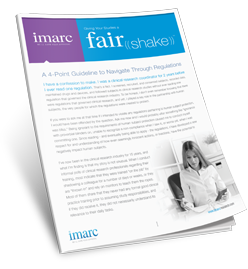
IMARC’s FAIR Shake technique takes a complicated maze of regulations and breaks them down into four simple areas your team can apply to clinical research questions.

Using this technique will give you confidence in resolving potential compliance issues and bridge the gap between knowledge and application. There’s a reason our FAIR Shake guide is one of our most-requested resources.

Topics: FDA Regulations, FAIR Shake technique, IMARC Research

Posted by John Lehmann on Mon, Jan 15, 2018

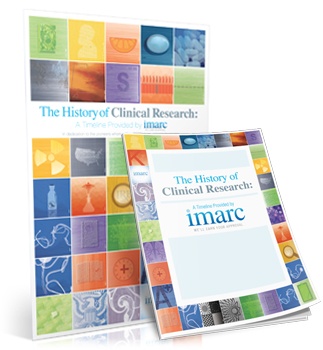
The History of Clinical Research

For research professionals involved in clinical trials, there is an immense responsibility of protecting human subjects, but history has taught us, unethical practice and disregard for the well-being of human subjects has occurred and will continue to occur.

Ensuring accurate and credible data from clinical trials and protection of human subjects is the role of every individual on the research team. The price for compromise is high; history provides an array of haunting reminders of our failure to uphold our obligation to ethical excellence in our work.

Topics: History of Clinical Research Timeline, IMARC Research

Posted by John Lehmann on Tue, Oct 11, 2016

IMARC Research Opens New Office

IMARC Research has expanded its footprint and opened a new office in the Minneapolis area. The office is located in Minnetonka, Minnesota and will be managed by Jim Moat, Senior Clinical Specialist. He is a Certified Clinical Research Specialist with more than 26 years of experience in medical device product development, having managed all phases of clinical study – from pre-market strategy to post-market surveillance.

Topics: IMARC Research, New Office, Minneapolis Area

Posted by John Lehmann on Mon, May 23, 2016

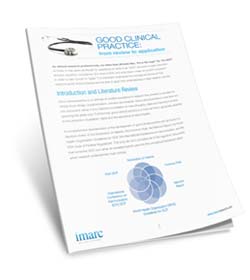
Good Clinical Practice: From Review to Applications

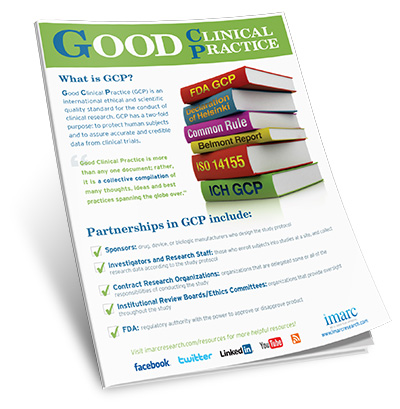
In clinical research many rules and regulations exist to govern the way research is conducted and to protect those patients who are participating in research. One of the standard principles directing clinical research is Good Clinical Practice. Good clinical practice is more than any one document; rather, it is a collective compilation of many thoughts, ideas and learning moments spanning the globe over.

Good clinical practice is an attitude of credible excellence in research that provides a standard for clinical study design, implementation, conduct and analysis. Furthermore, good clinical practice is a mind-set that is absolutely essential to the protection of patients’ rights and the assurance of data integrity. Many of these lessons stem from some of the tragedies in the history of clinical research which has formed and shaped much of the frame work today.


Topics: Good Clinical Practice, Whitepaper, IMARC Research

Posted by John Lehmann on Fri, Apr 08, 2016

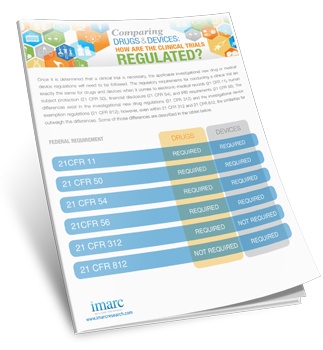
An Infographic: Comparing Drugs and Devices Trials

Several year ago, IMARC Research published a whitepaper outlining the differences between Drug and Medical Device clinical trials.  Since IMARC focuses primarily on medical device trials, we felt it was important to highlight the differences between the two trials.  It has proven to be one of our more popular whitepapers, so we have decided to offer everyone an infographic as a quick reference.

Topics: Drugs vs. Devices, IMARC Research, FDA

Posted by John Lehmann on Mon, Jan 15, 2018

The History of Clinical Research eBook

For clinical research professionals, the protection of human subjects has always been of paramount importance.  Doing so while ensuring accurate and credible data are obtained are the primary roles for every individual on a research team.  Unfortunately, history reminds us that unethical research practices and/or disregard for the well-being of human subjects has not only occurred in the past, but continues to do so today.

Topics: History of Clinical Research, eBook, IMARC Research

Posted by Scott Schisler on Mon, Nov 06, 2017

Did You Know WHO Published GCP Before ICH?


You may be familiar with IMARC Research’s History of Clinical Research (HCR). We recently released an eBook about it that briefly describes all of the images that currently make up the timeline. If you have visited our office, you may have also been given a guided tour of one of our most renowned resources. Due to the overwhelmingly positive feedback we have received, we will be highlighting each time point with a series of blogs that we plan to release over the course of the past couple calendar years.

Back in the early 1960’s, public perception of clinical research began to take a turn as talks and frightful images of the Thalidomide tragedy gained national news. In this case, Congress managed to pass new legislation to attempt to mitigate the issue (the Kefauver-Harris Amendment, respectively), but who couldn’t be left wondering “What’s the next terrible course of events that will happen?”

Topics: Good Clinical Practice, World Health Organization, History of Clinical Research, IMARC Research, International Conference on Harmonization

Posted by John Lehmann on Mon, Jan 15, 2018

The History of Clinical Research eBook

For clinical research professionals, the protection of human subjects has always been of paramount importance. Doing so while ensuring accurate and credible data are obtained are the primary roles for every individual on a research team. Unfortunately, history reminds us that unethical research practices and/or disregard for the well-being of human subjects has not only occurred in the past, but continues to do so today.

Topics: Sandra Maddock, History of Clinical Research, IMARC Research

Posted by John Lehmann on Thu, Nov 19, 2015

IMARC Expand Service Offerings

IMARC Research has launched independent oversight capabilities by adding Data Safety Monitoring Boards (DSMBs) and Clinical Events Committees (CECs) to its existing monitoring, auditing, training, project management and consulting services.

Topics: Sandra Maddock, IMARC Research

Posted by Shawn Kennedy on Thu, Sep 24, 2015

The Common Rule (1991)

You may be familiar with IMARC Research’s History of Clinical Research (HCR). We recently released an eBook about it that briefly describes all of the images that currently make up the timeline. If you have visited our office, you may have also been given a guided tour of one of our most renowned resources. Due to the overwhelmingly positive feedback we have received, we will be highlighting each time point with a series of blogs that we plan to release over the course of the 2014-2015 calendar years.

Topics: History of Clinical Research Timeline, IMARC Research, The Common Rule

Posted by Sandra Maddock on Mon, Jul 09, 2018

Do Form FDA 483s Matter Anymore?

For clinical researchers, our “grade card” comes when the FDA inspects us.  We all want to be told that we’ve operated in a compliant manner and that there were no findings.  The alternative is to receive a Form FDA 483 (483) for significant deviations at the close of the inspection.  When I got my first 483 as a research coordinator 18 years ago, I remember thinking to myself “I’m not going to let that happen again.”  In my opinion, it was an indication that we had not delivered A+ work.  Since the stakes are so high in this environment, and we’re asking patients to trust us to perform, it was a big wake up call for me. 

Topics: IMARC Research, FDA, Form 483s

Posted by John Lehmann on Fri, May 15, 2015

Product Accountability in Clinical Trials- Why is it important?

In order for a new medical product to reach patients it must first be proven safe and effective and then be approved for use by the governing regulatory body. Clinical trials are the vehicle to bring these innovative technologies to patients and evaluate them in support of regulatory approval. Unless a product is approved under the appropriate regulations for a specific use, it cannot be commercialized for that indication. In clinical research the products are still investigational, and even in a hospital setting, these products are treated differently.

Topics: Whitepaper, Product Accountability, IMARC Research, Clinical Research

Posted by John Lehmann on Fri, Jun 03, 2016

Auditing versus Monitoring: What’s the Difference?

In the realm of clinical research, two functions often work together to complement each other to create an additive impact on the overall quality and integrity of a clinical trial. The two functions are clinical monitoring and auditing. But how do these work hand-in-hand, and how are they different?

Topics: Whitepaper, IMARC Research, Auditing, Clinical Research, Clinical Monitoring

Posted by Shawn Kennedy on Wed, Mar 04, 2015

FDA Kefauver-Harris Amendment (1962)

You may be familiar with IMARC Research’s History of Clinical Research (HCR). We recently  released an eBook about it that briefly describes all of the images that currently make up the timeline. If you have visited our office, you may have also been given a guided tour of one of our most renowned resources. Due to the overwhelmingly positive feedback we have received, we will be highlighting each time point with a series of blogs that we plan to release over the course of the 2014-2015 calendar year.

Topics: History of Clinical Research, Kefauver-Harris Amendment, IMARC Research, FDA

Posted by Stephani Hulec on Wed, Mar 04, 2015

Case Study – Applying the FAIR Shake™

Since the suicide death of Dan Markingson in May of 2004, there has been a lot of debate as to whether or not the 26 year old psychiatric patient should have been approached to consent to participate in a clinical research trial for the comparison of three atypical antipsychotic drugs. Recently, there has been an article published in the Minnesota Daily about a petition signed by over 3,000 ethicists, researchers and scholars asking the University of Minnesota’s President to review the case to prevent future tragedies at the institution. Such a petition was created due to several errors in processes related to human subject protection.

Topics: FAIR Shake, University of Minnesota, Dan Markingson, IMARC Research

Posted by Natalie Jarmusik on Wed, Mar 04, 2015

The Guatemala Syphilis Experiment

You may be familiar with IMARC Research’s History of Clinical Research (HCR). We recently released an eBook about it that briefly describes all of the images that currently make up the timeline. If you have visited our office, you may have also been given a guided tour of one of our most renowned resources. Due to the overwhelmingly positive feedback we have received, we will be highlighting each time point with a series of blogs that we plan to release over the course of the 2014-2015 calendar year.

Topics: History of Clinical Research, Guatemala Syphilis Experiment, John Charles Cutler, IMARC Research

Posted by John Lehmann on Wed, Mar 04, 2015

Trust the Process – A Case Study

Merriam Webster defines a case study as a published report about a person, group, or situation that has been studied over time; also : a situation in real life that can be looked at or studied to learn about something.  Case studies can be useful to help highlight how to handle a particular situation, including the eventual outcome.

Topics: Audits, Case Study, IMARC Research, FDA, BIMO

Posted by John Lehmann on Wed, Mar 04, 2015

Helping to Inform and Educate

IMARC Research continues to focus on being an industry thought leader through our whitepapers, infographics, speaking engagement and blogs.  During 2014, IMARC Research continued this tradition by publishing content that help inform and education our industry.

Topics: Thought Leadership, Published Content, IMARC Research

Posted by John Lehmann on Wed, Mar 04, 2015

Risk Management in Clinical Research

As the regulators continue to raise the bar for quality clinical research investigations, IMARC has released a new whitepaper that discusses the principles of risk management and their application to clinical research.

Topics: Whitepaper, Risk Management, Guidance Document, IMARC Research, FDA

Posted by John Lehmann on Tue, Oct 24, 2017

Why Do We Need to Audit?

How is auditing different than monitoring?  Why do we need to audit?  Since these questions are so often asked, we decided to create a graphic that will help you understand when to consider an audit. In short, auditing brings an independent, quality assurance perspective to the clinical research landscape Investigational sites, sponsors, and vendors benefit from high-level process assessments and improvements. Experienced auditors leverage extensive training to help ensure subject safety, data integrity, and protocol and regulatory compliance.

Topics: Infographic, GCP, IMARC Research, Auditing

Posted by John Lehmann on Fri, Jun 03, 2016

Auditing versus Monitoring: What’s the Difference?

In the realm of clinical research, two functions often work together to complement each other to create an additive impact on the overall quality and integrity of a clinical trial. The two functions are clinical monitoring and auditing. But how do these work hand-in-hand, and how are they different?

Topics: Whitepaper, IMARC Research, Auditing, Clinical Monitoring

Posted by John Lehmann on Mon, Nov 06, 2017

IMARC Signs Agreement with European CRO

IMARC Research and TheraGenesis GmbH of Sutensee, Germany have signed a collaboration agreement to integrate and expand their combined resources, services and expertise in the development of medical devices. The agreement is solely a work-based collaboration with neither firm holding a financial stake in the other.

Topics: European CRO, TheraGenesis GmbH, IMARC Research

Posted by Natalie Jarmusik on Tue, Feb 23, 2016

Nazi Human Experimentation

You may be familiar with IMARC Research’s History of Clinical Research (HCR). We recently released an eBook about it that briefly describes all of the images that currently make up the timeline. If you have visited our office, you may have also been given a guided tour of one of our most renowned resources. Due to the overwhelmingly positive feedback we have received, we will be highlighting each time point with a series of blogs that we plan to release over the course of the 2014 calendar year.

Topics: History of Clinical Research, Nazi Human Experimentation, Human Experimentation, IMARC Research

Posted by John Lehmann on Wed, Mar 04, 2015

Misconduct in Clinical Research – Room for Improvement

IMARC Research believes history provides important examples of clinical research misconduct  that have helped establish a foundation for understanding the principles that guide modern clinical research.  If you visit our offices, you will see artwork that is featured in our history of clinical research timeline hanging on our walls that depict critical events in history that have helped shape and improve modern clinical research for the well-being of human subjects.

Topics: Whitepaper, Misconduct in Clinical Research, IMARC Research

Posted by Danielle Sas on Wed, Mar 04, 2015

Do you know the Sponsor - Investigator Role in Clinical Trials?

When the words “Clinical Research Trial” are heard, many questions may come to one’s mind. What is being tested?  What is involved? Where will it be taking place? Who came up with the trial? Who is paying for it? What doctors are participating? Many of these answers for an Investigational Device (IDE) clinical research trial can be found on ClinicalTrals.gov.

Topics: Sponsor- Investigator Role, IMARC Research, Clinical Monitoring

Posted by Shawn Kennedy on Mon, Nov 06, 2017

The Tuskegee Syphilis Study (1932 – 1972)

As we continue to blog about the events that comprise our History of Clinical Research: A Timeline, we focus this month on the infamous Tuskegee Syphilis Study.

Topics: History of Clinical Research Timeline, The Tuskegee Syphilis Study, IMARC Research

Posted by John Lehmann on Mon, Nov 06, 2017

Giving Your Studies a FAIR Shake™

Please take time to download and review IMARC Research’s white paper on the FAIR Shake™ training program.  The goal of this white paper is to introduce you to the concept of the FAIR Shake™ in an effort to foster a pattern of thinking that will allow you to navigate through the complexity of the regulatory framework in a very simple way that is based in regulatory fact as opposed to popular opinion.

Topics: FAIR Shake. Training Technique, IMARC Research

Posted by Shawn Kennedy on Wed, Jan 03, 2018

What Makes Good Clinical Research Training?

Recently, we have noticed an increase in the demand for training across the clinical research landscape.  This should come as no surprise with the constant advances in technology improving the way that clinical research studies are conducted.  Those of us involved in this privilege are continually striving to keep up, and continuing education is a regular part our profession.  In addition, FDA regulations require that individuals involved in the clinical research process be qualified by training and experience.  But what constitutes “adequate” training?  This a question often asked of us by the sponsors and investigators we work with.

Topics: FDA Regulations, IMARC Research, Clinical Research Training

Posted by Stephani Hulec on Wed, Mar 04, 2015

Electronic Data Capture - Principal Investigator Signatures?

As the clinical research world becomes increasingly technologically advanced, we have seen more and more sponsors choose to use Electronic Data Capture (EDC) Systems to document Case Report Form (CRF) data.  FDA published a guidance in September 2013 to address the questions associated with this growing trend.

Topics: FDA Guidance, Electronic Data Capture, Principal Investigators, IMARC Research

Posted by John Lehmann on Mon, Nov 06, 2017

Have You Suffered from Monitoring Pain Points?

Over the years, we have had many conversations with sponsors regarding their needs for monitoring support services.  It is clear that while many sponsors consider the outsourcing of their monitoring needs to a CRO, they have many concerns that they have shared with us.

Topics: Pain Points, IMARC Research, Clinical Monitoring

Posted by Stephani Hulec on Wed, Mar 04, 2015

Monitor Turnover – Tips to Minimize Challenges

As we in this industry are aware, turnover from both the sponsor and/or monitoring CRO is extremely high compared to other fields of service.  In order to have a monitor turnover rate lower than the industry standard, companies should recognize the importance of minimizing turnover whenever possible and proactively adapt strategies to do so.  However, in the event when turnover does occur, companies should also strive to make the transition to a new monitor as smooth as possible for both the sponsor and site(s).

Topics: Monitor Turnover, How to Minimize, IMARC Research

Posted by Brandy Chittester on Wed, Mar 04, 2015

What is the FAIR Shake™?

Topics: FAIR Shake, Whitepaper, IMARC Research

Posted by John Lehmann on Wed, Mar 04, 2015

How to Improve Individual Site Compliance

Topics: Site Compliance, Training, Investigator, Study Team, IMARC Research

Posted by John Lehmann on Fri, Jun 03, 2016

Monitoring as a Mindset

While procedures, checklists, guidance documents, report templates and all sorts of other things combine to form the infrastructure for monitoring, what is possibly even more important is the shared mindset.  The acceptance by all that regardless of the title, there is a shared responsibility in calling out issues, in looking purposefully at this document, in questioning that blank.

Topics: IMARC Research, Clinical Research, Clinical Monitoring

Posted by John Lehmann on Mon, Jul 09, 2018

IMARC Representatives Speaking at MAGI

Brandy Chittester, Director of Clinical Monitoring and Mary Lewis, Chief of Clinical Operations for IMARC Research will both be speaking at MAGI's Clinical Research Conference in Philadelphia, May 4-7, 2014. I hope you can join us and over 500 others.

Topics: Brandy Chittester, MAGI Conference, Mary Lewis, IMARC Research

Posted by Shawn Kennedy on Wed, Mar 04, 2015

1747 - James Lind

You may be familiar with IMARC Research’s History of Clinical Research (HCR). We recently released an eBook about it that briefly describes all of the images that currently make up the timeline. If you have visited our office, you may have also been given a guided tour of one of our most renowned resources. Due to the overwhelmingly positive feedback we have received, we will be highlighting each time point with a series of blogs that we plan to release over the course of the 2014 calendar year.

Topics: History of Clinical Research, James Lind, IMARC Research

Posted by Shawn Kennedy on Wed, Mar 04, 2015

The Book of Daniel – 605 BC

You may be familiar with IMARC Research’s History of Clinical Research (HCR).  We recently released an eBook about it that briefly describes all of the images that currently make up the timeline.  If you have visited our office, you may have also been given a guided tour of one of our most renowned resources.  Due to the overwhelmingly positive feedback we have received, we will be highlighting each time point with a series of blogs that we plan to release over the course of the 2014 calendar year.

Topics: History of Clinical Research, IMARC Research, Clinical Research

Posted by John Lehmann on Fri, Jun 03, 2016

Article Features Differences between Medical Devices and Drug Trials

Oftentimes there are questions about doing research with medical devices (as opposed to pharmaceuticals).  We recently highlighted in our whitepaper on the differences (and similarities) of doing research with drugs vs. devices, and also have an infographic summarizing the main points.

Topics: Drugs vs. Devices, Brandy Chittester, Master Control, IMARC Research, Clinical Research

Posted by Lauren Easley on Wed, Jan 03, 2018

2013 Top FDA Warning Letter Findings

For the fifth year, IMARC has searched through the warning letters posted on the FDA’s website to compile a list of the top findings for clinical investigators. This year, we noted twelve warning letters that were issued in 2013. In the past years, the most common citings tend to revolve around failure to follow the clinical investigational plan, insufficient recordkeeping, and inadequate subject protection. Interested to see if the trends continued for 2013?

Topics: Sponsors, FDA Warning Letters, IRBs, IMARC Research

Posted by John Lehmann on Tue, Jul 10, 2018

Documentation in Device Studies: Proving Patient Protection

Topics: Documentation, Medical Device Studies, IMARC Research, Clinical Research

Posted by Shawn Kennedy on Mon, Nov 06, 2017

The Hippocratic Oath – 500 BC

You may be familiar with IMARC Research’s History of Clinical Research (HCR).  We recently released an eBook about it that briefly describes all of the images that currently make up the timeline.  If you have visited our office, you may have also been given a guided tour of one of our most renowned resources.  Due to the overwhelmingly positive feedback we have received, we will be highlighting each time point with a series of blogs that we plan to release over the course of the 2014 calendar year.

Topics: History of Clinical Research, The Hippocratic Oath, IMARC Research

Posted by John Lehmann on Wed, Mar 04, 2015

New Infographic: Comparing Drug & Device Trials

Several years ago, IMARC Research published a whitepaper outlining the similarities and differences between drug and device clinical trials.  Since IMARC focuses primarily in the medical device space, we felt it was important to highlight the differences between the two trials.  It has proven to be one of our more popular whitepapers, so we have decided to offer an infographic as a quick reference.

Topics: Infographic, Drugs vs. Devices, IMARC Research

Posted by John Lehmann on Wed, Mar 04, 2015

Laying the Regulatory Groundwork for a Successful Physician-Sponsored IDE Study

When a Sponsor-Investigator conducts a device study, it may be referred to as a Physician-Sponsored IDE (PS-IDE). Chaos can sometimes ensue when one begins down the path of a PS-IDE. This whitepaper will attempt to make sense of that chaos by providing a brief overview of initiating a PS-IDE, the responsibilities of the investigator, the additional sponsor responsibilities assumed by the Sponsor-Investigator, and a thoughtful discussion on the records and reports of the Sponsor-Investigator.  Relevant FDA warning letter findings issued to Sponsor-Investigators and some suggestions to ensure a well-controlled clinical study are reviewed.

Topics: Whitepaper, IMARC Research, FDA, Physician-Sponsored IDE Study

Posted by Shawn Kennedy on Wed, Mar 04, 2015

IMARC Poll: What is your Favorite Regulation and Why?

We recently took a poll within the company regarding the following topic:  What is your favorite regulation, and why?  Here are some selected responses and the reasoning behind them:

Topics: FAIR Shake, 21 CFR 812, Federal Regulations, IMARC Research

Posted by John Lehmann on Mon, Jan 15, 2018

Download IMARC’s eBook: The History of Clinical Research

For clinical research professionals, the protection of human subjects has always been of paramount importance.  Doing so while ensuring accurate and credible data are obtained are the primary roles for every individual on a research team.  Unfortunately, history reminds us that unethical research practices and/or disregard for the well-being of human subjects has not only occurred in the past, but continues to do so today.

Topics: Sandra Maddock, History of Clinical Research, Clinical Research Timeline, eBook, IMARC Research

Posted by Danielle Sas on Wed, Mar 04, 2015

Case Study – Applying the FAIR Shake™

Since the suicide death of Dan Markingson in May of 2004, there has been a lot of debate as to whether or not the 26 year old psychiatric patient should have been approached to consent to participate in a clinical research trial for the comparison of three atypical antipsychotic drugs. Recently, there has been an article published in the Minnesota Daily about a petition signed by over 3,000 ethicists, researchers and scholars asking the University of Minnesota’s President to review the case to prevent future tragedies at the institution. Such a petition was created due to several errors in processes related to human subject protection.

Topics: Informed Consent Process, FAIR Shake, 21 CFR 20, IMARC Research

Posted by John Lehmann on Wed, Mar 04, 2015

New infographic: Risk-Based Monitoring Checklist

In a recent blog post, we provided an overview of the “Guidance for Industry: Oversight of Clinical Investigations – A Risk-Based Approach to Monitoring” that the FDA released this past August.  Risk-based monitoring continues to remain a hot topic as the industry navigates its comfort level with this new approach.

Topics: Risk-Based Monitoring, Infographic, IMARC Research

Posted by John Lehmann on Wed, Mar 04, 2015

How to Improve Individual Site Compliance

In order to run a well-controlled compliant study at the site level, one must ensure that the study team has been trained, and is knowledgeable on the rules and regulations. Although it is the Investigator who is responsible for the conduct of the study, there is a larger team at work to complete all the required activities. The research coordinator carries out many of the day-to-day activities and touches nearly every study milestone.

Topics: Research Coordinator, Site Compliance, Investigator, IMARC Research

Posted by John Lehmann on Wed, Mar 04, 2015

IMARC Research Launches YouTube Channel

IMARC Research has launched a new YouTube Channel that presents our people and services in a video format.  YouTube is the second largest search engine in the world (just behind Google) and since over 85% of Americans watch videos on-line, we thought it was time to launch our own channel.

Topics: Sandra Maddock, Medical Device CRO, YouTube Channel, IMARC Research

Posted by Brandy Chittester on Wed, Mar 04, 2015

Five Ways to be a Great Monitor

IMARC Monitors sometimes have a challenging job; they are often on the road, trying to balance work and home life.  They juggle multiple studies from different Sponsors, have many relationships to maintain, sites to visit, and reports to write.  At IMARC we want to always provide the very best monitoring services we can.  In order to do that we must have great monitors on staff, so, what makes a great Monitor?

Topics: IMARC Research, Clinical Research, Clinical Monitoring

Posted by John Lehmann on Wed, Mar 04, 2015

BioOhio’s Regulatory Forum

IMARC Research will be participating in BioOhio’s Regulatory Forum on October 3rd from 9:00 a.m. – 5:30 p.m. BioOhio has partnered with REU Associates to discuss regulatory issues that impact Ohio’s medical products industry. 

Topics: Risk-Based Monitoring, Medical Device CRO, BioOhio, Regulatory Forum, IMARC Research

Posted by John Lehmann on Wed, Mar 04, 2015

The Best Way to Document Your Work

When documenting your research observations, it is important to remember the adage, “If it wasn’t documented, it wasn’t done”. As research professionals, we have an obligation to uphold the highest ethical standards and make all possible efforts to comply with Good Clinical Practice. We must take credit for what we do - and to take credit for what we do, we must properly document our work.

Topics: Good Clinical Practice, ALCOA Checklist, IMARC Research

Posted by John Lehmann on Wed, Mar 04, 2015

The Difference is in the Details: Drugs vs. Devices

IMARC Research’s whitepaper investigates the differences between the drug and medical device clinical research process.  First and foremost, there is a common thread that ties the seemingly different clinical research processes together…patients.  Real people exist on the other side of an investigational product and they face risk when they choose to take part in a clinical research study.  So while the investigations of drugs and devices have their differences, by design these differences are intended to accomplish the game goal:  to safeguard those research participants while bringing safe and effective products to the market as quickly as possible.

Topics: Sandra Maddock, Drugs vs. Devices, IMARC Research

Posted by John Lehmann on Wed, Mar 04, 2015

Conducting a Well-Controlled Clinical Study When Clinical Data is Required

There continues to be much discussion over the FDA’s 510(k) program, which has led to controversy and confusion over the direction of the program.  In fact, we have posted many blogs devoted to this topic, so we thought it was time to create a whitepaper focusing on the topic.

Topics: Whitepaper, 510(k) Program, IMARC Research, FDA

Posted by Jacqui Lingler on Wed, Mar 04, 2015

How to Improve Individual Site Compliance

Topics: Research Coordinator, Site Compliance, Training, IMARC Research

Posted by Jacqui Lingler on Fri, Jun 03, 2016

Informed Consent Revisions - Using the FAIR Shake

It is a common question that follows an informed consent document revision- does the subject need to re-sign? The answer could be yes or no depending on the type of revision that was made to the document. 

Topics: Informed Consent, FAIR Shake, IMARC Research, Clinical Monitoring

Posted by Brandy Chittester on Wed, Mar 04, 2015

Because that is how we have always done it…

Topics: FAIR Shake™, 21 CFR 312.50, 21 CFR 812.40, IMARC Research

Posted by John Lehmann on Wed, Mar 04, 2015

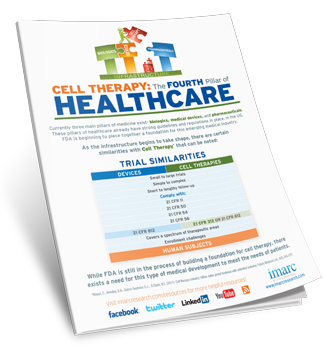
Cell Therapy: The Fourth Pillar of HealthCare

As the cell therapy market continues to grow, it’s important to note the similarities between medical device and cell therapy clinical trials. To help illustrate this, we’ve created an infographic, “Cell Therapy: The Fourth Pillar of Healthcare,” which is available for download.

Topics: Infographic, Cell Therapy, Fourth Pillar, IMARC Research

Posted by John Lehmann on Wed, Mar 04, 2015

GCP… What Does it Mean?

Do you know why rules, regulations and standards exist? What exactly is Good Clinical Practice and how does this help protect patients and data integrity?

Topics: Good Clinical Practice, Infographic, Human Subject Protection, IMARC Research

Posted by Jacqui Lingler on Wed, Mar 04, 2015

Monitoring as a Mindset

While procedures, checklists, guidance documents, report templates and all sorts of other things combine to form the infrastructure for monitoring, what is possibly even more important is the shared mindset.  The acceptance by all that regardless of the title, there is a shared responsibility in calling out issues, in looking purposefully at this document, in questioning that blank. 

Topics: Whitepaper, IMARC Research, Clinical Monitoring

Posted by John Lehmann on Wed, Mar 04, 2015

GCP… What Does it Mean?

Do you know why rules, regulations and standards exist? What exactly is Good Clinical Practice and how does this help protect patients and data integrity?

Topics: Good Clinical Practice, Infographic, IMARC Research, Clinical Research

Posted by John Lehmann on Wed, Mar 04, 2015

How to Tackle Complicated Clinical Trials

Recent widespread recalls of investigational products have led to harsher scrutiny and stricter rules from the Food and Drug Administration (FDA). Steps take to prepare for trials in the past are no longer enough. The path to FDA approval requires tremendous organizational skills and attention to detail to navigate; but with the right preparation and commitment to compliance, all of these challenges can be overcome.

Topics: Complex Clinical Trials, IMARC Research, FDA

Posted by John Lehmann on Fri, Jun 03, 2016

Product Accountability in Clinical Trials - Why is it Important?

In order for a new medical product to reach patients it must first be proven safe and effective and then be approved for use by the governing regulatory body. Clinical trials are the vehicle to bring these innovative technologies to patients and evaluate them in support of regulatory approval. Unless a product is approved under the appropriate regulations for a specific use, it cannot be commercialized for that indication. In clinical research the products are still investigational, and even in a hospital setting, these products are treated differently.

Topics: Medical Devices, Product Accountability, IMARC Research, Clinical Research

Posted by John Lehmann on Wed, Mar 04, 2015

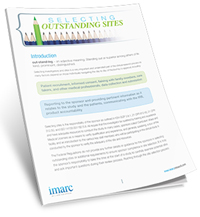
How to Select OUTSTANDING Sites!

Selecting outstanding sites is the key in running a well-controlled clinical trial.  Failure to identify outstanding sites could result in added costs and could lead to delays in bringing much needed products to the bedside.  Investing upfront time in the selection process could yield a positive return.  Today’s clinical research landscape typically allows for minimal resources under tight timelines, requiring sponsors to quickly, yet effectively, decide which sites are the right fit for the job. Selecting sites is the responsibility of the sponsor as outlined in ICH-GCP 5.6.1, 21 CFR 812.43, 21 CFR 312.50, and ISO 14155:2011(E). There is not a great deal of detail in these regulations to provide further guidance to sponsors. It is truly the sponsor’s responsibility to take the time at the start of the study to carefully examine potential sites and ask important questions during the review process.

Topics: IMARC Research, Outstanding Sites, Site Selection

Posted by John Lehmann on Wed, Mar 04, 2015

IMARC Research Announces Strategic Partnership with ImageIQ

IMARC Research, a  CRO offering monitoring, auditing and training services  and ImageIQ, an imaging contract research organization (CRO) and, have announced a partnership that will strengthen the abilities of both organization’s clients to manage the complexities of imaging within clinical trials, and to enhance FDA approvals by ensuring that scientific data is optimized and that processes are compliant.  ImageIQ will provide IMARC clients with their imaging and image analysis clinical trial expertise.  Conversely, IMARC will bring its 14 years of clinical trial management experience to ImageIQ clients that utilize ImageIQ’s imaging analytics and software development expertise.

Topics: ImageIQ, Sandra Maddock, Medical Device CRO, IMARC Research

Posted by Sandra Maddock on Wed, Mar 04, 2015

FDA Releases BIMO Metrics for 2012

The FDA Bioresearch Monitoring Program (BIMO) was created to: “Protect the rights, safety, and welfare of human research subjects involved in FDA-regulated clinical trials; Verify the accuracy and reliability of clinical trial data submitted to FDA in support of research or marketing applications; and To assess compliance with statutory requirements and FDA's regulations governing the conduct of clinical trials.” But, how exactly does FDA safeguard human subjects, ensure data integrity, and verify compliance with applicable standards?

Topics: BIMO Metrics, IMARC Research, FDA, Warning Letters

Posted by John Lehmann on Wed, Mar 04, 2015

IMARC Research: We’re on the Move!

We are pleased to announce that due to our continued growth, IMARC Research has moved to larger offices in order to accommodate our continued growth. Just 10 miles south of Cleveland Hopkins International Airport our Strongsville location will give us the added space and flexibility we need to continue to meet our clients’ needs in a high quality, efficient manner for many years to come!

Topics: Medical Device CRO, Ohio, Strongsville, IMARC Research

Posted by Sandra Maddock on Mon, Jul 09, 2018

Developing a Monitoring Mindset

While procedures, checklists, guidance documents, report templates and all sorts of other things combine to form the infrastructure for monitoring, what is possibly even more important is the shared mindset of those on a clinical research team.  The acceptance by all that regardless of the title, there is a shared responsibility in calling out issues, in looking purposefully at this document, in questioning that blank to facilitate running a well controlled, compliant clinical trial.

Topics: Developing a Mindset, IMARC Research, FDA, Clinical Monitoring

Posted by John Lehmann on Wed, Mar 04, 2015

The Keys to Choosing the Right CRO

In the past we have written blogs providing criteria for selecting a Contract Research Organization (CRO).    When you’re a sponsor or investigator and you are faced with the decision of hiring a CRO, picking the right organization can be difficult.   Finding the right fit for your organization requires a well thought out process with many key points to consider.

Topics: Choosing the Right CRO, Contract Research Organization, IMARC Research

Posted by Brandy Chittester on Wed, Mar 04, 2015

Your Site. Our Eyes.

We call it providing a "Third Set of Eyes."  Interestingly enough, most IMARC monitors have a background in nursing, or as research coordinators. It may very well be that this experience has assisted us in monitoring to empathize with each subject. After all, so many years were spent one-on-one with patients; we see them as individuals- not just subject numbers.

Topics: Informed Consent, Non-Compliance, IMARC Research, Clinical Monitoring

Posted by John Lehmann on Wed, Mar 04, 2015

IMARC’s December e-Newsletter

Today IMARC Research released its 23rd Issue of the IMARC eNewsletter and the last one of the 2012 year. As we reflect back on the year, IMARC Research has a lot to be thankful for. We continue to expand as the result of the trust placed in us by our clients and partners to handle their clinical research needs. We are thankful for these relationships that have helped us grow and prosper.

Topics: Compliance, eNewsletter, IMARC Research, Regulations

Posted by John Lehmann on Fri, Jun 03, 2016

Top 10 Tips- Get the Most Out of Your Clinical Trial Imaging

In clinical research having a well-run, compliant study is a top priority. Ensuring patients are protected and resulting data has integrity, it’s important to be experts in all aspects of your study. If your trial involves imaging, understanding how to get the most out of your data is not only smart- it’s cost effective. From a recent article published on GEN - Genetic Engineering & Biotechnology news, here are nine tips to help bring products to market faster with these ways of optimizing preclinical imaging:

Topics: ImageIQ, Top 10 Tips, IMARC Research, Clinical Research

Posted by John Lehmann on Wed, Mar 04, 2015

Friday Fun: What Motivates YOU in Clinical Research?

Recently we sent out a tweet asking this simple question: What Motivates YOU in Clinical Research? We were excited to see this answered, and retweeted by those in our industry.

Topics: GCP/Regulatory Training, IMARC Research, Clinical Research

Posted by John Lehmann on Wed, Mar 04, 2015

Imaging in Clinical Trials: The Unique Compliance Challenge

For all clinical trials, operating in compliance with the federal regulations, the agreements, the investigational plan, and the requirements of the IRB are critical to protect human subjects and to demonstrate quality and integrity of the resulting data. When imaging is introduced into a clinical research trial, a new layer of complexity is added, and additional considerations with regard to helping sites maintain compliance with the imaging requirements should be implemented.

Topics: ImageIQ, Sandra Maddock, IMARC Research, Imaging in Clinical Trials

Posted by John Lehmann on Wed, Mar 04, 2015

Did You Miss it?

We continue to reach out to our colleagues, customers, and friends in the most convenient places- from Facebook to Linked-In  to Twitter, and even in your very own inbox! Today we distributed the 21st issue of the IMARC e-Newsletter.

Topics: Medical Device CRO, eNewsletter, IMARC Research

Posted by Brandy Smith on Wed, Mar 04, 2015

How to Improve Individual Site Compliance

In order to run a well-controlled compliant study at the site level, one must ensure that the study team has been trained, and is knowledgeable on the rules and regulations. Although it is the Investigator who is responsible for the conduct of the study, there is a larger team at work to complete all the required activities. The research coordinator carries out many of the day-to-day activities and touches nearly every study milestone.

Topics: Site Compliance, Whitepaper, Improve Site Compliance, IMARC Research

Posted by John Lehmann on Wed, Mar 04, 2015

IMARC Research: We’re Growing!

IMARC Research is announcing the addition of eight new team members to help accommodate our continued growth.  Seven of the employees will hold the position of clinical research associate (CRA) and one member will be joining the business staff.

Topics: Medical Device CRO, Ohio, Cleveland, IMARC Research