Do you know why rules, regulations and standards exist? What exactly is Good Clinical Practice and how does this help protect patients and data integrity?
Topics: Good Clinical Practice, Infographic, Clinical Research



You want to keep your trial on track, but physical distancing and travel restrictions have made it difficult. Fortunately, IMARC has experience providing remote services.

Do you know why rules, regulations and standards exist? What exactly is Good Clinical Practice and how does this help protect patients and data integrity?
Topics: Good Clinical Practice, Infographic, Clinical Research
In the past we have written blogs providing criteria for selecting a Contract Research Organization (CRO). When you’re a sponsor or investigator and you are faced with the decision of hiring a CRO, picking the right organization can be difficult. Finding the right fit for your organization requires a well thought out process with many key points to consider.
Topics: Infographic, Regulatory Experience, CRO Selection
How is auditing different than monitoring? Why do we need to audit? Since these questions are so often asked, we decided to create a graphic that will help you understand when to consider an audit. In short, auditing brings an independent, quality assurance perspective to the clinical research landscape Investigational sites, sponsors, and vendors benefit from high-level process assessments and improvements. Experienced auditors leverage extensive training to help ensure subject safety, data integrity, and protocol and regulatory compliance.
Topics: Infographic, GCP, IMARC Research, Auditing

As the cell therapy market continues to grow, it’s important to note the similarities between medical device and cell therapy clinical trials. To help illustrate this, we’ve created an infographic, “Cell Therapy: The Fourth Pillar of Healthcare,” which is available for download.
Topics: Infographic, Cell Therapy, Chris Mason, FDA
Several years ago, IMARC Research published a whitepaper outlining the similarities and differences between drug and device clinical trials. Since IMARC focuses primarily in the medical device space, we felt it was important to highlight the differences between the two trials. It has proven to be one of our more popular whitepapers, so we have decided to offer an infographic as a quick reference.
Topics: Infographic, Drugs vs. Devices, IMARC Research
In a recent blog post, we provided an overview of the “Guidance for Industry: Oversight of Clinical Investigations – A Risk-Based Approach to Monitoring” that the FDA released this past August. Risk-based monitoring continues to remain a hot topic as the industry navigates its comfort level with this new approach.
Topics: Risk-Based Monitoring, Infographic, IMARC Research
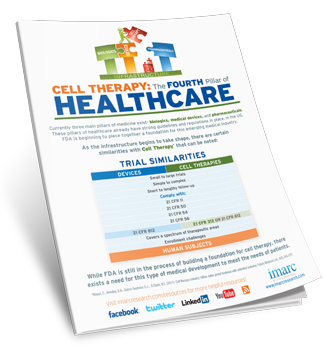
As the cell therapy market continues to grow, it’s important to note the similarities between medical device and cell therapy clinical trials. To help illustrate this, we’ve created an infographic, “Cell Therapy: The Fourth Pillar of Healthcare,” which is available for download.
Topics: Infographic, Cell Therapy, Fourth Pillar, IMARC Research
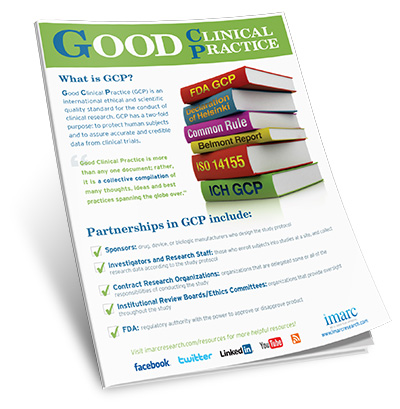
Do you know why rules, regulations and standards exist? What exactly is Good Clinical Practice and how does this help protect patients and data integrity?
Topics: Good Clinical Practice, Infographic, Human Subject Protection, IMARC Research
Do you know why rules, regulations and standards exist? What exactly is Good Clinical Practice and how does this help protect patients and data integrity?
Topics: Good Clinical Practice, Infographic, IMARC Research, Clinical Research
Do you know why rules, regulations and standards exist? What exactly is Good Clinical Practice and how does this help protect patients and data integrity?
Topics: Good Clinical Practice, Infographic, Clinical Research
The key players in a clinical investigation are infamously made up of Sponsors, monitors, investigative sites, and patients. A fundamental part of the team is also the Institutional Review Board (IRB), as they oversee the conduct of clinical research. Per the FDA’s IRB information sheet, “IRBs are responsible for continuing review of ongoing research to ensure that the rights and welfare of human subjects are protected.” That’s a tall order!
Topics: Infographic, 21 CFR 56, FDA, IRB