


<img height="1" width="1" style="display:none" src="https://www.facebook.com/tr?id=213807269037206&ev=PageView&noscript=1">
Blog

Compliance In Focus

remote services

LEARN MORE ABOUT REMOTE SERVICES

Keep Your Clinical Trial Moving from a Distance

You want to keep your trial on track, but physical distancing and travel restrictions have made it difficult. Fortunately, IMARC has experience providing remote services.

FILTER BY:

Newest Post

Posted by John Lehmann on Thu, Apr 27, 2017

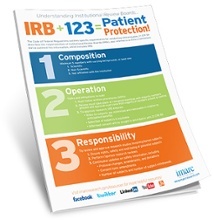
IRB + 123 = Patient Protection

The key players in a clinical investigation are infamously made up of Sponsors, monitors, investigative sites, and patients. A fundamental part of the team is also the Institutional Review Board (IRB), as they oversee the conduct of clinical research. Per the FDA’s IRB information sheet, “IRBs are responsible for continuing review of ongoing research to ensure that the rights and welfare of human subjects are protected.” That’s a tall order!

Topics: Patient Protection, FDA, IRB

Posted by John Lehmann on Fri, Mar 04, 2016

A Recipe for a Successful Study Start-up

There are many factors that go into a successful clinical study start-up.  Having the proper team assembled can be a critical factor in the success of any study. Choosing the right site is another factor that can make or break a successful study start-up.  Having a research coordinator and principal investigator that are engaged is important too. 

Topics: Study Start-up, IRB, Sponsor, Site Staff

Posted by Jaime Wynbrandt on Mon, Feb 01, 2016

Study Closure and Final Sponsor Report

We have all had sites that close prior to the study actually being completed. It is always asked if the site’s IRB allows them to close the study and submit the Sponsor’s final report when the study is completed or if the study needs to remain open at the site to allow the final report to be received by the IRB.

If the study needs to remain open with the IRB, this can become time consuming and costly if the study completion is several years away.  The site would need to submit for Continuing Review each year until the Sponsor’s final report is received.

Topics: FDA, IRB, Sponsor Report, Study Closure

Posted by Toni Hegyi on Fri, Dec 18, 2015

Enrolling Employees or Clinic Staff: Is it Acceptable?

Little discussion can be found around the question of whether or not employees of an institution should be permitted to participate as subjects in human research conducted by the institution they work for. To date, there is no specific guidance (protection/provisions) provided by the federal regulations governing research with human subjects. The Office for Human Research Protections (OHRP) presents consideration around students, employees, and normal volunteers in Chapter VI, “Special Classes of Subjects,” of its IRB Guidebook. Similarly, the Centers for Disease Control and Prevention (CDC) offers guidance for employee participation in research. While the enrollment of employees is allowed, there is a potential for fundamental ethical provisions to be compromised. Both the study sponsor and the Institutional Review Boards (IRB) or Independent Ethics Committees (IEC) have a responsibility to address the management of these issues:

Topics: Clinical Research, IRB, Enrolling Employees,, Clinical Staff,

Posted by John Lehmann on Tue, Mar 17, 2015

How Can You Bolster Clinical Trial Enrollment?

Your site is weeks past study initiation and all the candidates that you expected to be screening for the study have not materialized.  Would trial-related advertising or recruitment materials enhance your sites enrollment efforts?

Topics: 21 CFR Part 56, IRB, Clinical Trial Enrollment

Posted by Brandy Chittester on Wed, Mar 04, 2015

How Important is a Clinical Research Coordinator?

Often, when one thinks of the team that actually brings a new medical device or drug to market, the first people that come to mind are those at the sponsor company and the investigators at the individual sites – the leaders of the study.  What may be less known, though, is that often the study hinges on the shoulders of the Clinical Research Coordinator (CRC).  Briefly, CRCs are responsible for the accurate maintenance of the records for the trial, as well as many parts of the trial that otherwise may be overlooked.  Some of the major responsibilities of the CRC are:

Topics: Clinical Research Coordinators, Investigators, Clinical Research, IRB

Posted by Danielle Sas on Wed, Mar 04, 2015

Do You Know the Difference Between a Consent for Research and a Standard Consent for Treatment?

Coming from a background of working as a patient care nurse in the ICU, I would witness the consent process on a daily basis for biopsies, bronchoscopies, chest tubes, arterial lines, etc... These were non-research procedures; they were procedures to assist in the treatment of the critically ill. When I first started a career in research, I already knew that obtaining consent was more than a piece of paper and that it was a discussion and a process, but “a consent is a consent” for standard treatment in a hospital or for research, right? WRONG- I found out very quickly through IMARC’s training program that obtaining consent in research involves so many different specific elements, different from an informed consent for non-research procedures.

Topics: FDA, Clinical Research, IRB, Consent, 21 CRF 50.25

Posted by Emily Haglund on Wed, Mar 04, 2015

Sponsor-Investigators: Force the Formality

Sponsor-Investigators are uniquely dedicated and invested in clinical research. In a previous blog post, IMARC described how Sponsor-Investigators have to wear two hats and follow two sets of regulations.

Topics: Sponsor-Investigators, 21 CFR 50, FDA, IRB

Posted by John Lehmann on Wed, Mar 04, 2015

IRB Reporting Compliance - Whose Job is It?

Recently, when discussing Institutional Review Board (IRB)  adverse event reporting, a Project Manager for a leading medical device Contract Research Organization (CRO) brought up a valuable question regarding reporting compliance- whose job is it to ensure an investigator is compliant with IRB reporting policies?

Topics: FAIR Shake, Contract Research Organization, Reporting Compliance, IRB

Posted by Shawn Kennedy on Wed, Mar 04, 2015

On the Twelfth day of Clinical Research…The FDA gave to me…

If you work in clinical research, chances are you are familiar with the FDA regulations (21 CFR and all of its parts). If you’re like me though, you may have a strong understanding of these regulations but still need to reference a regulatory book from time to time if you want to be sure or cite something. Well IMARC’s present to you this year is a quick reference guide for regulatory time requirements for Investigators and Sponsors of medical device research, as well as IRBs. For space sake, we are paraphrasing. Please don’t feel obligated to get us any gifts in return. You can give the gift of human subject protection to every research subject involved simply by striving to meet these requirements.

Topics: FDA Regulations, Sponsors, IRB

Posted by Sandra Maddock on Wed, Mar 04, 2015

Essential Document Review, What are You Looking For?

As monitors we spend a significant amount of time reviewing the essential clinical investigation documents at the site during a monitoring visit.  These ‘essential documents’ are usually housed in a Regulatory Binder or sometimes they are referred to as an Investigator File.

Topics: Essential Documents, Monitoring Visit, IRB

Posted by Brandy Chittester on Wed, Mar 04, 2015

Record Retention: Just How Long Do We Keep All This Stuff?

You did it!

Topics: Monitor, Record Retention, Clinical Research, IRB

Posted by Brandy Chittester on Wed, Mar 04, 2015

A Recipe for a Successful Study Start-up

There are many factors that go into a successful clinical study start-up.  Having the proper team assembled can be a critical factor in the success of any study. Choosing the right site is another factor that can make or break a successful study start-up.  Having a research coordinator and principal investigator that are engaged is important too.

Topics: Study Start-up, Research Coordinator, Principal Investigator, IRB

Posted by John Lehmann on Wed, Mar 04, 2015

IRB… As Easy as 123!

The key players in a clinical investigation are infamously made up of Sponsors, monitors, investigative sites, and patients.  A fundamental part of the team is also the Institutional Review Board (IRB), as they oversee the conduct of clinical research. Per the FDA’s IRB information sheet, “IRBs are responsible for continuing review of ongoing research to ensure that the rights and welfare of human subjects are protected.” That’s a tall order!

Topics: Infographic, 21 CFR 56, FDA, IRB

Posted by Sandra Maddock on Wed, Mar 04, 2015

How Important is a Clinical Research Coordinator?

Often, when one thinks of the team that actually brings a new medical device or drug to market, the first people that come to mind are those at the sponsor company and the investigators at the individual sites – the leaders of the study.  What may be less known, though, is that often the study hinges on the shoulders of the Clinical Research Coordinator (CRC).  Briefly, CRCs are responsible for the accurate maintenance of the records for the trial, as well as many parts of the trial that otherwise may be overlooked.  Some of the major responsibilities of the CRC are:

Topics: Informed Consent, Monitor, Clinical Research, IRB

Posted by John Lehmann on Wed, Mar 04, 2015

When Should an IRB Shut a Site to Enrollment?

During a recent monitoring visit to a site, I was witness to an IRB in action.  Going in, I knew that this site had multiple issues.  Three monitors were at the site during this time as there was an incredible amount of data to review.  As I began looking at the data for the study, it was apparent that there were many inconsistencies at this particular site.

Topics: Site Enrollment, 21 CFR 56.113, IRB

Posted by John Lehmann on Wed, Mar 04, 2015

Sponsor and IRB: Direct Communication?

I came across an interesting article which talked about sponsor communication with an IRB.  In a nutshell, it explained: Sponsor communication with IRBs has long been deemed inappropriate and since the 1980’s, sponsors having direct contact with an IRB has been frowned upon.  Per Paul Goebel, president of Paul W. Goebel Consulting, Inc., a clinical research consulting firm, and former chief of CDE’s Institutional Review Branch, “When the regs were first written, some FDA officials said the communications should go through the principal investigator to keep the sponsors from bullying the IRBs and to keep IRBs safe from undue influence by the sponsors.”

Topics: Direct Communication, FDA, IRB, Sponsor

Posted by John Lehmann on Fri, Jun 03, 2016

Ensuring Proper Protections for Vulnerable Research Subjects

The Code of Federal Regulations define vulnerable research subjects, and how those vulnerable subjects should be protected. 21 CFR 50.53 describes the circumstances under which children may participate in an investigation involving greater than minimal risk and no prospect of direct benefit . In order for these subjects to participate in clinical research trials, it is the researcher’s duty to ensure that these special protections are respected. It is unimaginable that these federally mandated laws and regulations could be discounted and ignored.

Topics: john lehmann, Clinical Research, IRB

Posted by John Lehmann on Wed, Mar 04, 2015

Santa & the IRB

Dr. K. Kringle
Adjunct Professor of Child Psychology
Far Northern University

Topics: IRB, Warning Letters