You may be familiar with IMARC Research’s History of Clinical Research (HCR). We recently released an eBook about it that briefly describes all of the images that currently make up the timeline. If you have visited our office, you may have also been given a guided tour of one of our most renowned resources. Due to the overwhelmingly positive feedback we have received, we will be highlighting each time point with a series of blogs that we plan to release over the course of the 2014-2015 calendar year.
On July 12, 1974, President Richard Nixon signed the National Research Act into law. In doing so, the National Commission for the Protection of Human Subjects of Biomedical and Behavioral Research was created. The main purpose of the act was for the newly established commission to identify basic ethical principles to be followed when conducting biomedical and behavioral human subject’s research. Additionally, the commission was tasked with developing guidelines that would help the medical community conduct research in accordance with the principles they set forth. Some concepts the commission were to consider included:
Read More
Topics:
Tuskegee Syphilis Study,
History of Clinical Research Timeline,
The National Research Act
On April 1st, the FDA issued a draft guidance that provides more comprehensive information for industry and CDRH on the processes associated with panel device meetings. The new draft guidance document, Procedures for Meetings of the Medical Devices Advisory Committee, pertains to the to 17 of the 18 Medical Devices Advisory Committee (MDAC) panels overseen by FDA's Center for Devices and Radiological Health (CDRH), the FDA center in charge of regulating medical devices.
Once finalized, the updated guidelines will replace a 2000 CDRH guidance document on the panel process and a 1991 blue book memo. Thus, the guideline clarifies the circumstances in which the CDRH consults with a device advisory panel, the conduct of panel meetings and the expected timelines to prepare for a panel meeting.
Read More
Topics:
Medical Device,
Draft Guidance,
FDA,
CDRH
When documenting your research observations, it is important to remember the adage, “If it wasn’t documented, it wasn’t done”. As research professionals, we have an obligation to uphold the highest ethical standards and make all possible efforts to comply with Good Clinical Practice. We must take credit for what we do - and to take credit for what we do, we must properly document our work.
Read More
Topics:
Good Clinical Practice,
Federal Regulations,
ALCOA Checklist
IMARC Research’s new whitepaper examines the similarities and differences between the current US regulations and places them within the context of any number of roles found within the realm of clinical research. While there are no direct references within the regulations as to what types and to what degree training is required, a well-developed training curriculum is a prerequisite for quality research.
Read More
Topics:
Medical Device,
GCP/Regulatory Training,
IMARC Research Whitepaper
The informed consent process is arguably one of the most important parts of a clinical research study. Fromthe Principles of ICH GCP: the rights, safety, and well-being of the trial subjects are the most important considerations and should prevail over interests of science and society. Proper informed consent ensures that the patient is aware of the risks and requirements of being in a research study and has voluntarily agreed to participate in research. The regulations, CFR part 50 also cover the importance, rules and process of informed consent.
Read More
Topics:
Informed Consent,
Research Coordinators,
GCP
Proper training assures sponsors organizations that their research meets all the industry standards of compliance, and that their clinical studies will be conducted in a well-controlled, high quality manner that will withstand the rigors of regulatory inspection.
Read More
Topics:
IMARC University,
Online Training,
Training Fundamentals Checklist
Former FDA Commissioner Margaret Hamburg says FDA is still honing its medical device regulatory process so it strikes a balance between patient safety and industry’s desire to market their products. Speaking at the National Press Club in Washington D.C., which might be her last public appearance as commissioner. She indicated that she is not sure the U.S. or Europe have gotten the balance right yet.
Read More
Topics:
Margaret Hamburg,
FDA,
Medical Device Regulatory Process
Recent widespread recalls of investigational products have led to harsher scrutiny and stricter rules from the Food and Drug Administration (FDA). Steps take to prepare for trials in the past are no longer enough. The path to FDA approval requires tremendous organizational skills and attention to detail to navigate; but with the right preparation and commitment to compliance, all of these challenges can be overcome.
Read More
Topics:
Medical Devices,
Complicated Clinical Trials,
Medical Device CRO,
FDA
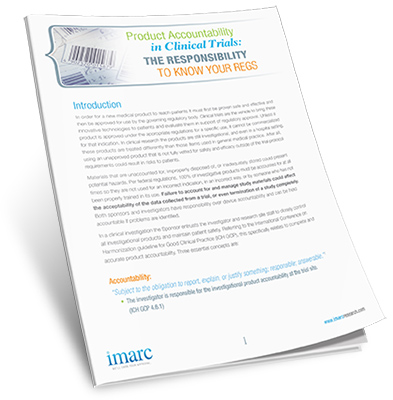
In order for a new medical product to reach patients it must first be proven safe and effective and then be approved for use by the governing regulatory body. Clinical trials are the vehicle to bring these innovative technologies to patients and evaluate them in support of regulatory approval. Unless a product is approved under the appropriate regulations for a specific use, it cannot be commercialized for that indication. In clinical research the products are still investigational, and even in a hospital setting, these products are treated differently.
Read More
Topics:
Whitepaper,
Product Accountability,
IMARC Research,
Clinical Trials
Recently, the FDA issued a final guidance document regarding medical device data systems, medical image storage devices, and medical image communications devices. The FDA also held a webinar in February 2015 to support this guidance document.
Read More
Topics:
Medical Device,
FDA Guidance,
Medical Image Storage Devices,
Medical Image Communications Devices